Labour has a serious anti-Semitism problem – and Jeremy Corbyn is failing to fix it


By Jonathan Arkush

1 April 2016 • 5:42pm

Jonathan Arkush, the president of the Board of Deputies of British Jews, has called on the Labour leadership to “exorcise” the party’s “antisemitic demons”, following a string of incidents within the party.Earlier this month, Mr Corbyn came under pressure to suspend Vicki Kirby, the vice chair of the Labour’s Working branch, who was promoted despite tweeting that Jews have “big noses” and “slaughter the oppressed”.In the past few days, it has also emerged that Labour councillor and former Lord Mayor of Bradford Khadim Hussain was suspended from the Party after promoting a cartoon on social media bemoaning the emphasis schools place on teaching the Holocaust “and the six million Zionists that were killed.”

Source: Labour has a serious anti-Semitism problem – and Jeremy Corbyn is failing to fix it

Eichmann Letter Rediscovered

Eichmann letter pleading for mercy

Our memory of the Eichmann trial is still fresh in our memory following Amos Hausner’s visit in 2015.  Recently, Eichmann’s handwritten letter pleading for mercy following his conviction was rediscovered:

After he was convicted and sentenced to death in Israel for his role in the annihilation of millions of Jews by Nazi Germany, Adolf Eichmann pleaded for his own life.

“There is a need to draw a line between the leaders responsible and the people like me forced to serve as mere instruments in the hands of the leaders,” pleaded Eichmann — the Nazi war criminal who oversaw the lethal logistics of the Holocaust — in a letter dated May 29, 1962, the day that Israel’s Supreme Court rejected his appeal.

Eichmann asked the Israeli president, Yitzhak Ben-Zvi, for a pardon, arguing, “I was not a responsible leader, and as such do not feel myself guilty.”

Read more…

Holocaust haunts Lithuanians as painful past comes to light

ruta-vanagaite-70229898

Ruta Vanagaite

After Daniel Gold’s presentation in 2014, we were left wondering about why we hadn’t already heard  much about how Lithuanians had supported, aided and abetted German efforts to persecute Jews in their country.  This article is welcome news.

Lithuanians are taking an agonising closer look at their forefathers’ role in killing Jewish neighbours during the Holocaust, a dark chapter of the Baltic country’s history that was hidden for decades.

A series of books and films has triggered national soul-searching by making the point that while Lithuanians were the victims of Nazi and Soviet occupation of the country, at times they too were perpetrators of crimes and their victims were Jews.

Bestselling author Ruta Vanagaite, who co-wrote “Our People” (Musiskiai) with top Israeli Nazi hunter Efraim Zuroff, is the latest to spark difficult discussions.

Writing the book turned out to be deeply personal and painful when she discovered her grandfather had collaborated with Nazis by working for a commission compiling lists of Jews in 1941.

Read more….

CHRISTCHURCH: 5 Broken Cameras: Sunday March 6

5 Broken Cameras Itinerary copyOn Sunday, the award-winning documentary “5 Broken Cameras” will be shown at the Workers’ Education Association in Gloucester Street Christchurch. One of the filmmakers, Emad Burnat, will also be attending and the organisers promise an extended Q&A period.  The showing is part of nationwide tour.
The event is organised by:
  • Kia Ora Gaza
  • Christchurch Palestine Organisation
  • The Solidarity Movement for Free Palestine and
  • New Zealand Palestine Solidarity Network
The film won an award at the prestigious 2012 Sundance Festival; the Golden apricots award at the 2012 Yerevan International Film Festival, Armenia; for Best Documentary Film, won the 2013 International Emmy Award, and was nominated for a 2013 Academy Award.
It was initially developed by the Greenhouse Development Project, a Mediterranean development project initiated by an Israeli foundation and sponsored by the European Union.
Later it received funding from international and Israeli sources such as the New Israeli Cinema Fund (Israel), the Jan Vrijman Fund (Netherland), ITVS (USA).
Still later, funding was provided by Israel’s Channel 8, Dutch Television IKON, and sources in Canada, South Korea, and the UK. Ultimately French television and the CNC French Cinema Fund provided help.
A survey of critical reviews of the film indicates clear themes:
  1. The film presents a one-eyed pro-Palestinian view of the Middle Eastern conflict; and
  2. Does not attempt to present a perspective from the settlers’ or the security forces’ perspective; and
  3. The film itself has been artistically and technically, well produced.
For this reason, we believe that the documentary is worthwhile viewing, even if it is just to behold it’s artistic and technical brilliance. Nonetheless, as a piece of ethical independent journalism, it is not. It is instead, a great piece of advocacy journalism, that is, propaganda.
In particular, viewers should bear in mind that criticism of the content has focused on two significant areas:
  1. That Israeli security forces use unnecessary force; some have noted that there is footage which has been heavily edited in order to contrive its message; and
  2. That it ignores the fact that Palestinian violence caused the security fence or wall to be constructed.
For further reading:
  1. CAMERA.org
  2. Stand with us

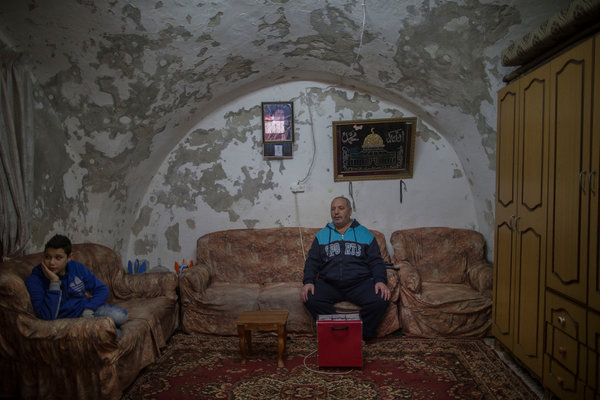
Evictions in Walled Old City Stir Up a ‘Hornet’s Nest’

Kudos to the NY Times for admitting that an article that they ran on evictions in the Old City should have also included interviews from both sides of the argument.

Editors’ Note: January 26, 2016
The Jerusalem Journal article on Jan. 15 about Palestinian residents of Jerusalem’s Old City who face eviction by Israeli organizations gave an incomplete description of the legal disputes in several cases. The descriptions were based on the tenants’ accounts; the article should have included additional information from court documents or from the landlords. (The landlords are organizations that have reclaimed properties owned by Jews before Israel was established in 1948.)

Source: Evictions in Walled Old City Stir Up a ‘Hornet’s Nest’

France’s Hollande: ‘Intolerable’ for Jews to hide skullcaps | The Times of Israel

President Francois Hollande:  Following Marseille machete attack, president says citizens should not be forced to hide for fear of assault because of their religion

“It is intolerable that in our country citizens should feel so upset and under assault because of their religious choice that they would conclude that they have to hide,” Hollande said following Monday’s attack on a kippa-wearing teacher in the southern city of Marseille.

The French leader’s comments came two days after a machete-wielding teen who claimed inspiration from the Islamic State attacked the Jewish teacher, lightly injuring him.

The knifing of Benjamin Amsellem prompted Zvi Ammar, head of Marseille’s Israeli Consistory, to warn Jews against wearing a traditional skullcap — known as a kippa — in public, sparking a debate over the issue.

Source: France’s Hollande: ‘Intolerable’ for Jews to hide skullcaps | The Times of Israel

New Poll: Over 70% of French Public Believes Antisemitism on Rise in France | Jewish & Israel News Algemeiner.com

70 percent of the French population do not think Jews should refrain from wearing yarmulkes, though 71% say antisemitism is increasing in France

70 percent of the French population do not think Jews should refrain from wearing yarmulkes, though 71% say antisemitism is increasing in France

While a majority of French respondents to a new survey believe Jews should not stop wearing their skullcaps in the wake of a series of recent attacks, an even greater number considers antisemitism on the rise in their country, the French-Jewish news service JSS reported on Sunday. According to the Odoxa survey, conducted for French digital channel iTélé and the weekly magazine Paris Match, 70 percent of the French population do not think Jews should refrain from wearing yarmulkes, though […]

Source: New Poll: Over 70% of French Public Believes Antisemitism on Rise in France | Jewish & Israel News Algemeiner.com

Unlikely Hero

Taisia Kharchenko, left, with one of the Jewish women she helped save, Sonya Bershtein.

Saturday, 17 October 2015

By Anne Marie McDonald

Taisia Kharchenko [nee Melnik] is a small, frail woman in her late 80s, who is living out her twilight years in a rest home in Wanganui. She seems an unlikely hero; but as a teenager Taisia risked her own life to save the lives of 13 other people.

Taisia’s name – along with that of her mother Aleksandra Melnik and brother Viktor Melnik – is inscribed on the wall of the Garden Of The Righteous in Israel, memorialising the three as Righteous Among The Nations. This is an award given to non-Jews who risked their own lives to save Jews persecuted by the Nazis during World War II.

Taisia received the Righteous award in 1994, for hiding, providing forged documents for, and smuggling to safety, 13 Jews.

Taisia is not well enough to be interviewed but one of her daughters, Natalia Brown, was happy to share her mother’s courageous story.

From a young age, Taisia knew that life could be hard.

She was born in 1926, the second of four children, in Vidoshnya, a small village in western Ukraine [then the USSR]. When Taisia was 12, her father was declared “an enemy of the people” by the Stalin regime, and killed.”

It was very hard for my grandmother because she had never worked before,” Natalia said.”

She was left with four children, and she had no way to earn any money.”

Locals rallied around to help the family – but, because of the political scandal, it was not relatives or Ukrainian friends who came to their rescue, it was the Jewish community.”

Vidoshnya was a very Jewish place; it was more Jewish than Ukrainian. The Jews felt very sorry for my grandmother because of what had happened to my grandfather, and they helped her,” Natalia said.

Life became precarious for Ukranian Jews in 1941 when the Germans began moving into western Ukraine. Jews were ordered to wear yellow stars, which immediately identified them as Jews, and to hand their valuables over the Germans. In the town of Proskurov [now known as Khmelnytskyi], near Vidoshnya, the Jewish population was forced into a ghetto and made to do hard labour. Many were killed outright, and others died through overwork. In November 1941, several thousand people from the ghetto were taken outside the city and murdered by the Germans.

“My mother had a Jewish friend called Sonya Bershtein. She was the same age as my mother’s older sister, but she was friendly with my mother and with the whole family. My grandmother said, ‘Sonya, please come to us and we will hide you from the Nazis.’

“Sonya said, ‘I cannot go without my mother.'”

SO IN DECEMBER 1941 Taisia and her brother, who were just 15 and 12 years old at the time, were able to rescue Sonya and her mother Faina and bring them safely to the family home. There they stayed hidden for 11 months.

Natalia said the family knew only too well the consequences of their actions.

“If they had been found, [the Nazis] would have killed the Jewish family and the Ukrainian family – everybody. Sonya’s cousin’s family had been hidden by a Ukrainian family, but they were found and all of them killed. They were taken to the town square and killed in front of everybody. Another family was burned alive in their house when Jews were found there.

“It was a warning that this is what will happen if you are found with Jews in your house.”

Undeterred, the family took in four more Jews: Faina Bershtein’s sister, Polya Kreizman, and her three young children. The Kreizmans stayed for a month, until Taisia was able to obtain false Ukrainian papers for them. These papers allowed Polya to find safe employment on a kolkhoz, or collective farm.

Towards the end of 1942 the Nazi efforts against Ukrainian Jews intensified, and they began searching houses for hidden Jews. The Melniks contacted two Russian men who were smuggling Jews out of Ukraine, and they agreed to take Sonya and Faina into Romania.

Later, Taisia arranged for the smugglers to take other Jewish people into Romania. As a German ally, Romania was a relatively safe place for Jews.

Natalia Brown with her mother’s Righteous Among The Nations award.

Natalia Brown with her mother’s Righteous Among The Nations award.

All 13 Jews Taisia and her family helped survived the war, and most of them emigrated to the United States.

Ukraine’s Jewish population suffered greatly under German occupation. More than a million of them were killed by the Nazis or their Ukrainian collaborators between 1941 and 1945. The most notorious massacre of Jews in Ukraine was at the Babi Yar ravine outside Kiev, where 33,771 Jews were killed in a single operation on September 29, 1941.

By 1959, the Jewish population in the Ukraine had declined by 70 per cent compared to what it had been before World War II. Besides the widespread murder by the Nazis, many Jews emigrated to Israel after the war.

SONYA BERSHTEIN was among those who went to Israel. As for Taisia, she stayed in Ukraine, became a nurse, married an engineer, and had two daughters.

She and Sonya maintained a life-long friendship, and in 1996 Taisia and her husband joined Sonya in Israel. They were able to do so because of Taisia’s status as a Righteous Among The Nations. Taisia’s husband lived for just one year after they emigrated, and Taisia stayed in Israel for another decade.

“It was easier for her in Israel. Ukraine was separating from Russia during Perestroika [a programme of widespread reform of the USSR], and it was a poor country. But Israel is a very religious country, and it’s very much for the Jews,” Natalia said.

As Taisia got older it became more difficult for her to live on her own so Natalia, who had emigrated to New Zealand from Russia in 1995 after the death of her only son, arranged for Taisia to join her in New Zealand.

Sonya died earlier this year.

“Even after Mum came to New Zealand they talked on the phone every week. They were very old, and they couldn’t remember anything, but they were always talking on the phone,” Natalia said.

Natalia was an adult before she knew the true story of how her family had helped Jews during the war.

“In my childhood I never heard this story. I knew that Mum and Grandma had saved Sonya, but with the Communists in power people couldn’t talk much. After Perestroika, people started talking more openly.”

Natalia believes her mother has always been haunted by the fear and terror of those times during the Nazi occupation.

“She told me when I visited her in Israel once, that sometimes she couldn’t sleep because of all the memories. And she said she didn’t understand how she and Sonya both survived. Life was so dangerous.”

Taisia’s only descendant is her granddaughter, Natalia’s niece, Polina, who lives in Russia and is very interested in her family’s history.

“Polina is making a family tree and wants to know as much as she can about her grandmother’s experiences during the war,” Natalia said.

“She wants to know the stories so that she can pass them on to her children, when she has them, so that they are never forgotten.”

Source: Unlikely Hero

Uruguay elected to UN Human Rights Council?!

Maduro UN

Often Israel is criticized for flouting UN Resolutions. Such critics assume that all that the UN does, is true and noble. If you ever wondered how dysfunctional the UN can get, then check this out:

“It’s a black day for human rights,” said Hillel Neuer, executive director of UN Watch, a Geneva-based non-governmental human rights group.

UN Watch, together with two other human rights groups, released a report yesterday urging UN member states to oppose the election of nine countries committing egregious human rights violations. Only two of those were defeated: Pakistan and Laos.

“The election of even more rights abusing regimes — on a body that already counts China, Russia, Cuba and Saudi Arabia as members — marks another severe blow to the credibility and efficacy of a body that was supposed to improve on its discredited predecessor.”

Virtually the entire EU voted for Ethopia and Togo as world judges of human rights.

UN Watch presented the report at a press briefing yesterday at UN headquarters, together with the Human Rights Foundation and the Lantos Foundation.

“With three out of the five regional groups having run uncontested slates, the elevation of oppressive governments sends the message that politics trumps human rights. The UN today is letting down millions of victims worldwide who look to the world body for protection.”

“If we allow Venezuela to be in charge of freedom of assembly, Burundi in charge of police accountability, and UAE in charge of labor rights, we are simply turning the UN into a laughingstock.”

Read more.

Uruguay elected to UN Human Rights Council?!