Making sense of the Israeli-Gaza conflict

Gaza-RocketHere is a presentation given at the recent AGM that gives the history of Gaza and looks at the debatable issues that arise from the conflict, including:

  1. How did the Arab-Israeli conflict come about in the first place?
  2. Why is Israel putting Gaza under siege?
  3. Why is Israel attacking Gaza?
  4. Why doesn’t Israel just ignore Hamas since their rockets are so ineffective anyway?
  5. Since Hamas’ rockets are so puny, why does Israel attack on such a heavy handed scale?
  6. Why did Israel escalate things and cause so many civilian casualties by ordering a ground offensive?
  7. Why is Israel targeting civilians?
  8. Why does the UN and many of Israel’s “allies” criticize the way Israel conducts war?
  9. Why is the civilian death toll so high in comparison to combatant casualties?
  10. Why doesn’t Israel leave them alone and let them get on with their lives?

Download the presentation and bibliography.

New Zealand’s Ban on Kosher Slaughter

This is Hal Levine’s interesting analysis.  A worthwhile read on the ethics of the ban and how it leaves the tolerance of other Jewish customs and traditions with respect to NZ society and law in question.

ABOUT THE AUTHOR

Hal Levine received his Ph.D from S.U.N.Y. Stony Brook in 1976 while a lecturer at Victoria University of Wellington. He did his initial fieldwork on urban ethnicity in Papua New Guinea. His PhD and the monograph Urbanisation in Papua New Guinea: A Study of Ambivalent Townsmen (co-authored with M. Levine), published by Cambridge University Press in 1979, was based on this research.

In 1981 he did a study of the fishing community of Stewart Island, New Zealand. A number of papers published in widely scattered journals were put together by the Anthropology Department and issued as Stewart Island: Anthropological Perspectives on a New Zealand Fishing Community . Hal’s next two research projects centred on Maori claims to fishing resources before the Waitangi Tribunal, and Jewish identity in New Zealand.

Being Jewish in New Zealand with Ann Beaglehole was published by Pacific Press in 1995 . It was followed by a monograph on the three ethnic identity projects entitled Constructing Collective Identity . The latter book was published by Peter Lang in 1997 with a grant from Victoria University’s Faculty of Humanities and Social Sciences.

Hal has more recently published papers dealing with debates about the meaning of iwi, Samoan chiefly practices in Wellington, and the implications of surrogate motherhood for the anthropological study of kinship. He has taught a wide variety of introductory and advanced papers in anthropology and is currently putting together a course about the interrelationships between society, culture and internal experience.

Where is the outrage?

Gaza-RocketBy Arsen Ostrovsky

Published in the Telegraph

8 July 2014

You see, as most people in the UK were waking up this morning, and those in Europe, United States and elsewhere around the world were going about their daily routines, here in Israel over one million people were running for cover from a hail of rockets being rained down by Palestinian Hamas terrorists in Gaza.

In the last 24 hours alone, over 120 rockets have been fired on southern Israel. That’s approximately five rockets per hour. By the time I finish this article, odds are that count will have risen to 125 rockets.

To put things in context: one million Israelis is roughly 13 per cent of the population. Thirteen per cent of the UK population equates to about 8.4 million people, or the entire population of London.

A number of Israelis have already been injured, though thankfully without fatalities. The only reason more have not been hurt is because Israel has invested millions of dollars in bomb shelters and the Iron Dome defence system. Meanwhile, Hamas, whose very raison d’être is the destruction of Israel and which is recognised as a terrorist organisation both by the EU and UK, has invested millions of dollars in foreign aid into more rockets.

So, where is the outrage?

Since the beginning of this year, Gaza terrorists have fired more than 450 rockets on Israel, with about half of them coming since mid-June, when two Hamas terrorists kidnapped and brutally murdered three Israeli teenagers.

Why is it that a majority of the international community only notices when Israel undertakes its sovereign right, and obligation, to defend its citizens? Can you imagine if even one rocket was fired on London, Washington, Paris or Moscow? This is simply intolerable and no country can, or should, tolerate such attacks on its people.

Where is the outrage from the United Nations, which does not hesitate for a moment to call a “special emergency session” on the “Question of Palestine” or pass the umpteenth resolution blindly condemning Israel? But 24 hours after the rocket attacks on Israel started, I am still waiting for even one syllable of condemnation from the UN Security Council, the UN General Assembly or the Human Rights Council.

Read more.

Just Dance!

Every two years, Aotearoa’s capital city plays host to the New Zealand Festival.  Promoted as a spectacle of culture and arts for “explorers and dreamers,” this year’s extravangaza was rather unfairly sidelined by a small political protest.

John Minto

John Minto

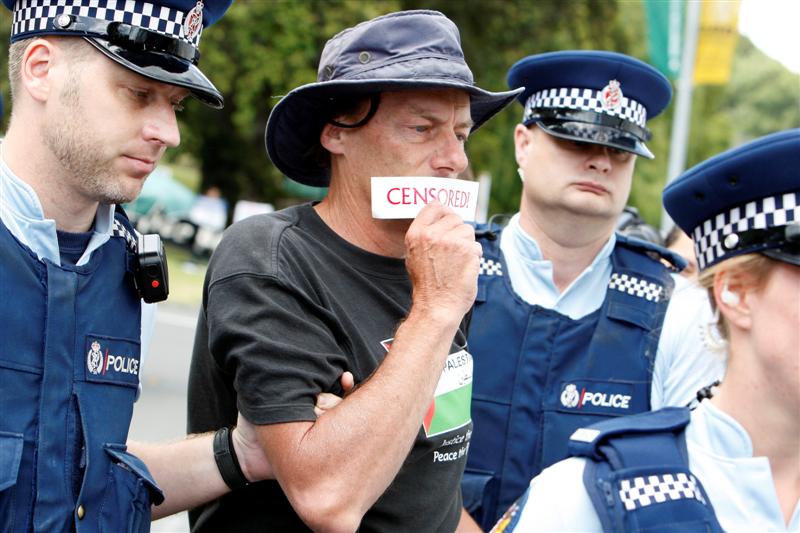
As part of the so-called “BDS” (Boycott, Divestments and Sactions) movement agianst Israel, the country’s most prominent protestor, John Minto, once again rounded up his rent-a-mob troops to protest the involvement of Israel’s renowned Batsheva Dance Company in the festival.

Minto and his cohorts first demanded the government deny members of the dance company visas to the country.  In well publicised letters to Foreign Minister Murray McCully and Immigration Minister Michael Woodhouse, the group urged that they provide “practical solidarity to the Palestinian struggle” by refusing them.

The group insisted this action was required for New Zealand to fulfil its “obligations” to the Palestinians under international law. “Such a decision will be welcomed by Palestinians as part of the international pressure to bring change to the policies of the Israeli apartheid state as well as by those countries thinking supporting New Zealand’s bid for a UN Security Council seat,” the letter said.

In a widely reported decision, McCully announced the company would not be refused visas. Noting the government pursues “a balanced and constructive approach to the Israel-Palestinian issue,” he said that “the Batsheva Dance Company is made up of dancers from around the world and is coming to New Zealand as part of a wider Australasian tour.”

Not to be denied his time in the spotlight, Minto, who last year unsuccessfully ran for the Auckland mayoralty, then organised a protest outside the Batsheva Dance Company’s Saturday night performance.

Ultimately, this resulted in about 40 anti-Israel protesters facing off against a slightly larger counter-demonstration organised by Wellington Jewish community leader David Zwartz. Extensive publicity was generated by, and afforded to, Minto’s small protest.

Local media, long in thrall to Minto’s ability to generate headlines and outrage among the general public, probably paid the anti-Batsheva campaign and eventual protest more attention than the numbers warranted.

However, to the eyes of this observer, there was something a bit different and positive about the coverage of the anti-Batsheva campaign compared to  past efforts by Minto and his pro-BDS comrades. That difference was the coverage given to the counter-demonstration in views opposed to those of the anti-Israel activists.

When McCully refused to deny visas to the dance company it was reported. When Zwartz said the allegations that Israel was an apartheid state were racist and unfounded it was reported. When the Auckland Jewish Council co-Chairs described the anti-Batsheva campaign as “a cheap publicity stunt that should be exposed for its sinister agenda” it was reported.

Apart from the less mainstream media — like Scoop and a number of blogs, all of which have always tended towards a pro-Palestinian bias, local media reported both sides of the story. The STUFF website even published a review of the Batsheva show.

Comments from Batsheva’s artistic director, Ohad Naharin, were also widely reported. Naharin said he was “disappointed to see a group of intelligent people wasting their money and their energy on something that won’t result in anything.”

He told local media he had experienced this kind of “impotent activity” for years. “The situation in the West Bank is tragic and indeed every effort must be made to change it. If I believe that boycotting our performances could bring any progress in ending the occupation, I would join the boycott myself.”

In an article in the National Business Review journalist John Daly-Peoples went even further. He compared the anti-Batsheva campaign to the “spirit of Nazi Germany” and said the pro-Palestinian activists would be “using the same harassment techniques used by the Nazis to close down Jewish and liberal performances in the 1980s.”

The boycotting of cultural event is misguided, Daly-Peoples seed. “As it is cultural activities, such as Darren Barenboim’s West-Eastern Divan Orchestra, which have promoted active dialogue and been one of the significant ways in which the Israelis and the Palestinians have made some reconciliation.”

He also pointed out that the “myopic approach to boycotting lets the Russians off the hook… despite them funding the play A Midsummer’s Nights Dream, also on during the festival, and despite the country’s stand on gay rights and their support of the Assad regime which is undermining the Palestinian cause.”

While Minto in his acolytes claim success — on the somewhat spurious grounds that five people bailed up by his protest said they decided not to attend the performance — this seems closer to wishful thinking than to reality.

It is hard to know what the reasonably measured response of the media and the general public to this particular campaign might mean in the broader scheme of things.

However, it seems that the views of the Festival’s Executive Director, Sue Paterson, that festival shows should be selected solely on the basis of artistic merit was the primary winner in this saga.

Source:  Miriam Bell, Australian-Israeli Review, April 2014.

The Fatah-Hamas Agreement

Gaza-RocketThere is the criminal failure of the international community, as both accomplice and accessory before the fact, to make any meaningful effort to prevent endless salvoes of terrorist rocket attacks against Israeli civilians for over nine years.

As we saw with the Iranian arms shipment aboard the Klos-C last month, Iran’s sponsorship of terrorism continues unabated — even as the international community is rehabilitating its extremist regime.

Three hundred and thirty two drone attacks against Al Qaida and Taliban targets on Pakistani territory since 2005 demonstrate U.S. President Barack Obama’s strong resolve against terrorists that threaten the United States. Only last week, the latest wave of air strikes launched or enabled by his government against Al Qaida networks in Yemen killed 55 suspected extremists, possibly including master bomb-maker Ibrahim al-Asiri.

Of course no one expects the U.S. to send drones in reply to the news that the Palestinian Authority [PA], upon which he has lavished billions of dollars and thousands of hours of diplomacy, was going into business with Hamas, which the United States has branded a terrorist organization.

But one could hope for something more forceful from Washington than State Department spokesman Jen Psaki’s weak and vacillating response in which she attempted to take the heat off Hamas and the PA by taking a gratuitous dig at Israel. “There have been unhelpful steps from both sides throughout this process,” she said.

If the US response was feeble, the EU’s was treacherous.

Like America and several other countries, the EU designates Hamas as a terrorist organization. Yet the spokesman for Catherine Ashton, EU foreign affairs head, actually welcomed the proposal to bring Hamas into the PA.

Though shameful, this is far from surprising. It is part of a lengthy pattern of witting or unwitting EU encouragement of Middle Eastern terrorism.

The EU has contributed its taxpayers’ money to paying the salaries of convicted Palestinian terrorists via unconditional donations to the PA amounting to billions of dollars since 1994. Some of this money has also been spent on school textbooks, television programs and other PA propaganda that incite hatred and terrorism against Israel.

Ashton and the EU have called repeatedly for an end to the Israeli-Egyptian security operation on land and sea around Gaza. The operation is designed to prevent predominantly Iranian-supplied munitions and materiel for terrorism from entering the Gaza Strip, and to stop Gaza terrorists and weapons moving to attack Israeli or Egyptian targets.

At the same time, the EU, like the UN, has usually remained mute in the face of volley after volley of Iranian-supported rocket attacks from Gaza directed against the civilian population of Israel. These rockets are fired mainly by Hamas and their terrorist bedfellows, the Palestinian Islamic Jihad. Silence and inaction by such significant international bodies as the UN and the EU must, in these circumstances, add up to at least a degree of culpability.

Robert Serry, the UN Special Coordinator for the Peace Process, seems to have swallowed Abbas’s suggestion to him that reconciliation with Hamas will be on the basis of “recognition of Israel, non-violence and adherence to previous agreements.” On that “understanding,” the UN, like the EU, apparently welcomes and even supports the prospect of a terrorist group’s incorporation into the PA.

Were Hamas indeed to commit — plausibly — to such undertakings, then Israel could of course continue peace negotiations and cooperation with the PA on current terms. But other than Abbas’s words to Serry, there is no indication of this and, in the real world, Hamas is not likely even to consider such conditions.

Prime Minister Netanyahu therefore had no choice other than to suspend the peace process. This was his obligation to the Israeli people and to the international community. How could he possibly continue to negotiate with an entity that is itself negotiating with a vicious, murderous and unrelenting terrorist group hell-bent on the destruction of Israel and outlawed around the world?

Of course Abbas knew full well when he agreed to unity with Hamas that this would end the peace negotiations. But this is only the latest in a series of steps that Abbas has taken to sabotage the peace process. He rejected U.S. Secretary of State John Kerry’s framework principles last month; he has repeatedly refused to discuss PA recognition of Israel as the national homeland of the Jewish people; and at the end of March he initiated a move to join 15 international organizations, contravening an agreement to make no unilateral moves in the international arena during the period of the peace negotiations.

One of the greatest challenges in the peace process, should it be resumed at some point, is resolving Israel’s security concerns in the West Bank. Since the Israel Defense Forces left Gaza in 2005, Palestinians have fired into Israel over 8,000 rockets, killing 44 Israelis and injuring more than 1,600.

A damaged apartment building in Ashdod, following a direct hit by a rocket fired from Gaza, in November 2012. (Image source: IDF)

In addition, Gaza terrorists have seized every available opportunity for other forms of attack against Israeli soldiers and civilians including kidnappings, shootings, suicide bombs, anti-tank missiles and Improvised Explosive Devices [IEDs].

Iran, sworn to Israel’s destruction, as are its Gaza-based proxies, has funded, armed, energized and directed both Hamas and Palestinian Islamic Jihad. As we saw with the Israeli interdiction of the Iranian arms shipment aboard the Klos-C only last month, Iran’s sponsorship of terrorism continues unabated — even as the international community is rehabilitating its extremist regime.

Especially in a region and among neighbours that are becoming even more unstable, violent and unpredictable, Israel must ensure that in the event a Palestinian state should ever reach fruition, the West Bank does not become a second Gaza. The bloody consequences of that for the Israeli people would be far greater than from anything Hamas could hurl out of the Strip.

Kerry has proposed international troops to provide security against attacks on Israel from the West Bank. Few Israelis believe that they could rely on such a force to protect them. There are the historical precedents for the failure of peacekeeping forces in the region and beyond, especially when the going gets tough. And in the West Bank, the going would get very tough very soon and very often.

There is the criminal failure of the international community, as both accomplice and accessory before the fact, to make any meaningful effort to prevent endless salvoes of lethal terrorist rocket attacks against Israeli civilians for over nine years.

Worse still, when Israel has been forced to respond to protect its citizens, it has been stabbed in the back by the international community, who have accused it of war crimes.

The UN’s ill-conceived and deeply flawed 2009 Goldstone Report, for example, amounted to nothing less than incitement to terrorism.

And then there is the spectacle that we have witnessed over the past few days, of the pusillanimous and equivocating international response to plans for an active and violent terrorist group to join the PA.

Confronted by world leaders who lack the moral courage to face down terrorists whom even they themselves have designated as such, Israel is entirely right in its assumption that when it comes to security it can rely only on its own moral strength and its own armed forces.

ABOUT THE AUTHOR

Colonel Richard Kemp spent most of his 30-year career in the British Army fighting terrorism and insurgency, including in Iraq, the Balkans, South Asia, and Northern Ireland. He was Commander of British Forces in Afghanistan in 2003. He was also involved in the direction of national policy at the highest level, working at the Joint Intelligence Committee and as a member of COBRA, the UK national crisis committee. He writes regularly for The Times and speaks worldwide on terrorism, international security and other issues.

SOURCE:  Gatestone Institute.

Recognising Reality: The debate over Israel as a “Jewish State”

JewishStateIsraeli Prime Minister Binyamin Netanyahu’s position that a permanent status agreement resulting in a two state solution must include explicit Palestinian recognition of Israel as a Jewish state is rejected by Palestinian Authority (PA) President Mahmoud Abbas, and is a key point of contention in the peace process.

For Netanyahu, and for most Israeli Jews, mutual recognition of Jewish and Palestinian national rights is integral to the logic of a lasting agreement based on two states for two peoples.

Most Israeli Jews wish to preserve Israel’s current character as a democratic state with a Jewish majority; a state that allows Jews to express the universal legal right to national self-determination, but which also protects fully the rights of non-Jewish minorities.
At the Davos Summit in January, US Secretary of State John Kerry said: “We all know what the endgame looks like: … mutual recognition of the nation-state of the Palestinian people and the nation-state of the Jewish people.”


Why is this an issue now?

Since accepting the principle of creating a sovereign Palestinian state in 2009, Binyamin Netanyahu has stressed that a permanent status agreement must include Palestinian recognition of Israel as a Jewish state. In a recent statement he clarified that he wanted the Palestinians to “recognise the national rights of the Jewish people in the State of Israel.” While stating that this must be part of the final agreement, at no point has Netanyahu made this a precondition for talks with the Palestinians.

PA President Mahmoud Abbas has taken a firm stance against this demand, creating a significant obstacle in John Kerry’s search for an agreed framework for continuing talks.


What do Israelis mean by a Jewish state?

For Netanyahu, and for most Israeli Jews, mutual recognition of Jewish and Palestinian national rights in the territory west of the Jordan River is integral to the logic of a lasting peace based on two states for two peoples.

Most Israeli Jews want to preserve Israel’s character as it is today, as both democratic and Jewish. Israel today is ‘Jewish’ in the sense that it has a Jewish majority, allows that majority to express the universal legal right to national self-determination, and is open to Jews who wish to immigrate. This is no different to most other states which express the right of the ethnic majority to self-determination, whilst still protecting the rights of minorities.

Reference to a ‘Jewish state’ does not mean a state based on religious precepts, or a state which discriminates against non-Jews.

All Israelis today – both the 75% Jewish majority and non-Jewish minorities – enjoy equal rights before the law and freedom of religion. Non-Jewish minorities enjoy collective rights in education, language and religion. Discrimination based on religious or ethnic identity is illegal.

To maintain Israel’s Jewish majority, and its character as the nation state of the Jewish people, Israel wants Palestinian refugee claims to be resolved through the creation of a Palestinian state.


Why are the Palestinians resistant to this idea?

Rejection of Jewish national rights – indeed rejection of the idea that the Jews constitute a distinct national group – is deeply rooted in the Palestinian-Arab narrative. It is linked to the belief that all of Palestine is rightfully an Arab territory and that Arab refugees from the 1948 war and their descendants should have the ‘right of return’ to territory now within Israel’s borders.

However, Palestinians have not always been so opposed to recognition of the Jewish state. The Palestinian declaration of independence in 1988 referenced the UN 1947 Partition Plan, which explicitly refers to the creation of a Jewish and an Arab state side by side.

When former US President Bill Clinton addressed the refugee issue in his parameters for a peace agreement in 2000, he noted Israel could not accept a right to immigrate that would “threaten the Jewish character of the state,” adding that, “A new State of Palestine is about to be created as the homeland of the Palestinian people, just as Israel was established as the homeland of the Jewish people.” The PLO’s detailed response raised no challenge to this basic principle.

In a June 2004 interview with Haaretz, the late PA President Yasser Arafat was asked explicitly whether he understood that “Israel has to keep being a Jewish state.” He responded, “Definitely, definitely, I told them we had accepted [this] openly and officially in 1988.”

However, since Netanyahu has raised the profile of the issue, the PA leadership has become very resistant. They claim not only that it prejudices Palestinian refugee claims but that Israel’s demand threatens minority rights in Israel, or involves asking Palestinians to renounce their identity or history. Israel rejects these latter two objections.


What have world leaders said?

Secretary of State John Kerry: “We all know what the endgame looks like: … mutual recognition of the nation-state of the Palestinian people and the nation-state of the Jewish people.”

US President Barack Obama: “Palestinians must recognise that Israel will be a Jewish state.”

German Chancellor Angela Merkel: “We in the federal government support a two-state solution – a Palestinian state and a Jewish state of Israel.”

French President François Hollande: “France’s position is known. It is that of a negotiated solution for the State of Israel and the State of Palestine – both with Jerusalem for a capital – can coexist in peace and security. Two States for two peoples.”

British Prime Minister David Cameron: “Britain has played a proud and vital role in helping to secure Israel as a homeland for the Jewish people… imagine, as John Kerry put it: ‘mutual recognition of the nation state of the Palestinian people and the nation state of the Jewish people.'”

Canadian Prime Minister Stephen Harper: “We share with Israel a sincere hope that the Palestinian people and their leaders will choose a viable, democratic, Palestinian state, committed to living peacefully alongside the Jewish state of Israel … Our view on Israel’s right to exist as a Jewish state is absolute and non-negotiable.”


What is the historical background?

• The founder of modern political Zionism Theodore Herzl helped launch the movement with a pamphlet published in 1896 entitled Der Judenstaat (“The State of the Jews”). Following many centuries of antisemitic persecution in Europe, he and most other Zionist leaders envisaged a secular, democratic, Jewish majority state in which non-Jews would live as full and equal citizens.

• The British government committed to support “the establishment in Palestine of a national home for the Jewish people” in the 1917 Balfour Declaration. This goal received international legal sanction under the League of Nations Mandate granted to Britain in 1922, which gave recognition to, “the historical connection of the Jewish people with Palestine and to the grounds for reconstituting their national home in that country.”

• In 1947 the United Nations General Assembly approved with a two thirds majority a plan to partition Palestine into a Jewish and an Arab state. The proposal was accepted by the Jews but rejected by the Arabs, who then launched the 1947-48 Arab-Israeli War.

• Israel declared its independence on the basis of the UN resolution on May 1948. Israel’s first Prime Minister David Ben Gurion declared the establishment of: “A Jewish State in Eretz-Israel [the Land of Israel], to be known as the State of Israel,” which would ensure “complete equality of social and political rights to all its inhabitants.” The State of Israel was admitted to the United Nations in May 1949.

Source:  BICOM (British-Israel Communications and Research Centre)

Protest down under is upside down

JohnMinto_ShaharPeerThe boycott, divestment and sanctions (BDS) movement has, in many ways, legitimized anti-Semitism by masquerading as criticism against Israeli policies. It has become an acceptable talking point in many societies, so much so that some governments have even adopted their arguments and blindly followed the BDS’s direction. However, while the BDS tries to portray itself as a movement seeking human rights, its real more sinister purpose often shines through. New Zealand was the scene of two recent protests that highlighted this very fact.
In Auckland, a gay parade was being held through the streets of the city. In that parade was a float, sponsored by the Israeli embassy. As the parade commenced, a group of protesters broke through the barricade, carrying placards and demonstrating against ‘Israeli apartheid’. They went on to accuse Israel of ‘pinkwashing’ their human rights record, in order to distract from its violation of Palestinian human rights.
The reality that a gay or lesbian person can live their life any way they want without discrimination in Israel, is an extremely inconvenient fact for them.  Yet, the absurdity of this is that the protesters who protest in the name of ‘human rights’ attended a gay parade and protested against Israel – the only country in the Middle East that actually has human rights for gay and lesbian people.
In addition to the protest in Auckland, another protest was taking place in Wellington, led by John Minto, an enthusiastic supporter of the BDS movement who has led countless protests against Israel – including picketing outside the ASB tennis tournament every time Shahar Peer appears. This time, the protest was against the Israeli Batsheva Dance Company who were performing there. When confronted by a counter demonstration from the local Jewish community along with Christian friends, he stated that he was happy the counter protesters were there, as the debate needed to be had in public. What John Minto failed to mention is that anytime an Israeli attends New Zealand in any official capacity, he would be the first one at the door protesting!
In summary, we have ‘human rights’ campaigners, protesting against Israel’s human rights for gay people.  And we also have an anti-Israel protester calling for public debates, as long as no opposing view to his own is displayed.
It all makes sense, doesn’t it?  Then again, we do drive on the wrong side of the road.

Justin Amler is a South African born, Melbourne based writer who has lived in South Africa, New Zealand and Australia and is currently working in the Information Technology industry. He is an avid contributor to discussions on Israel, writing frequently to local newspapers. He has a keen interest in politics and creative writing.

Anne Askey: Purim: Memories and Questions

13025270475_8784bf4f5f_q

Anne Askey

Last weekend, we were treated to a fascinating talk on Purim, its role as a memorial and how the role of questions continue to unearth further lessons and meanings for the modern reader.

Here were some gems that we noted from the talk:

“Without memory a people is doomed to live only in the present. (This is the tragedy of Alzheimer’s disease – individuals who have lost their ability to remember live only in the present and as the disease progresses, they may in fact lose any sense of who they are.)  Much the same way, a people group ceases to be a people group if it loses its collective memory. Civilizations that have lost their collective memory are in fact lost civilizations. They no longer exist.”

“Abraham Joshua Heschel, one of the greatest Jewish thinkers of the 20th Century reminds us that the essential things in Judaism are not abstract ideas but concrete events. God reveals himself in Concrete ACTION and EVENTS and Jews remember the events. They are not a people who define God, but a people who, through remembering, are witnesses to God’s existence.”

If you would like to obtain the PowerPoint slides and her speaking notes, click here and here.

Anne Askey is an Educator and currently teaches at the Halswell Residential School.  We are privileged to count her as a long time Friend of Israel.

Johannes Gerloff interviews

_3PT7285Johannes Gerloff is a German journalist who has lived in Israel for 20 years.  He recently visited New Zealand and while here, he gave an interview on the Palestinian conflict.

Here are excerpts of the interview:


Review: Deca Dance, Batsheva Dance Company

 Last updated 09:40 22/02/2014

Deca Dance

POWEFRFUL: Batsheva Dance Company show that dance can break down barriers and make us feel as one.

NZ Festival 2014

REVIEW: DANCE

Deca Dance, Batsheva Dance Company (Israel)

St James Theatre, till February 24

Reviewed by Ann Hunt

This extraordinary company is a perfect choice for the opening night of the New Zealand Festival. Inventive, exhilarating, moving – it is everything that the festival aims to be and then some.

It comes as no surprise that Batsheva is recognised as one of the world’s leading contemporary dance companies. It is superb.

Artistic director/ choreographer Ohad Naharin takes contemporary dance to a whole new level. His choreography is astonishingly varied and inventive. The dancers soar, contract, roll, flick, shake, all with split-second timing in ways rarely seen before.

All 18 are phenomenal. They risk everything and hold back nothing. Their bodies are sublimely fluid, with magnificent upper body reach. But it is their absolute unflagging energy that takes one’s breath away.

Deca Dance is comprised of 10 dances taken from previous Naharin choreographies. Crudely, a kind of Batsheva’s greatest hits. Yet so integrated are the excerpts that the work has a wonderful cohesion and appears a unified whole.

One of the most impressive aspects of Batsheva is the way in which gender is almost completely ignored. The men are soft and pliable, the women tough and strong. Then suddenly they reverse. Really, they can do anything. Everyone works for the good of the whole and hence, they are the ideal ensemble.

One excerpt was understandably the audience’s favourite and mine too. Dressed in slick black suits and fedoras, the dancers slowly left the stage and coolly selected members of the audience, from all three levels of the theatre. Back on stage, however, the coolness disappeared and the party began.

Not once were the participants put down or ridiculed by the dancers, as so often is the norm in this kind of interaction. At the close of the piece, everyone dropped to the floor, leaving one couple dancing in close embrace.

Then suddenly the male dancer hit the floor as well, leaving the lone woman happy to take her well-deserved ovation.

If ever you needed evidence that dance can break down barriers and make us feel as one, then this was it.

Source:  http://tinyurl.com/knfm3l4