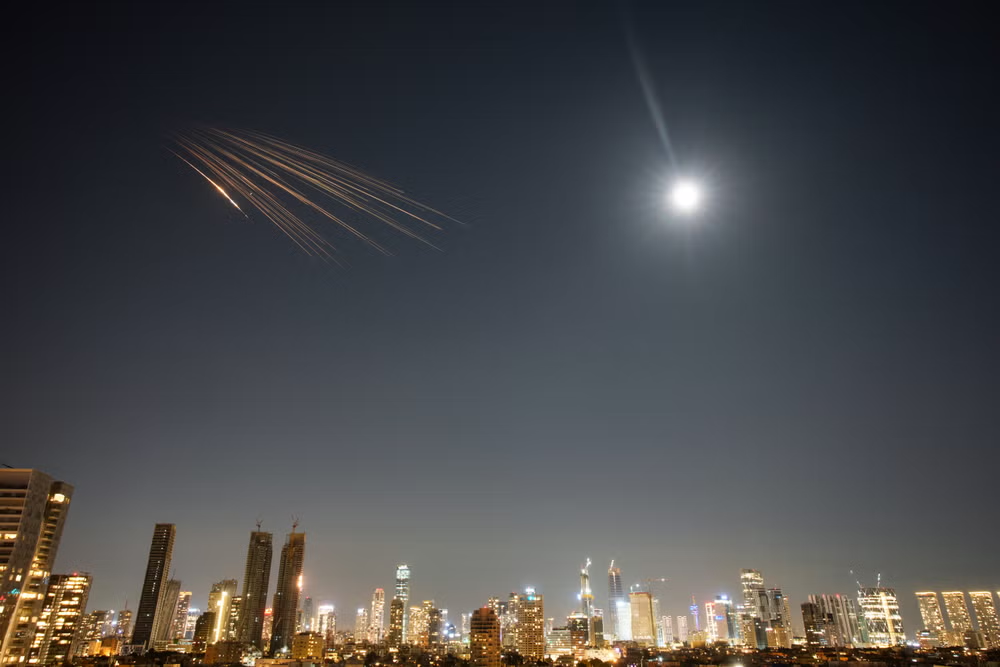
Israel’s new strategic reality: The China-Iran alliance

Melissa Chen
Melissa Chen

For years, Israel treated China as a distant economic partner — a country that bought our tech, invested in our infrastructure, and stayed politely out of our regional wars.

Melissa Chen’s conversation with Haviv Rettig Gur makes one thing painfully clear:
China is not a bystander. It is now one of the central enablers of the forces trying to destroy Israel.

This isn’t theory. It’s happening in real time — in Iran’s oil fields, in Gaza’s tunnels, in the UN Security Council, and even in the TikTok feeds of Western teenagers.

1. China Is the Financial Lifeline of the Iranian Regime

Iran’s ability to survive sanctions, suppress dissent, and fund its terror network depends overwhelmingly on Beijing.

From the interview:

“It literally buys more than 80% of Iran’s total oil exports… and does all the work necessary to bypass American sanctions.”

China buys Iranian oil at deep discounts, but in such massive quantities that it keeps the regime solvent. That money becomes:

  • Ballistic missiles for Hezbollah
  • Drones for Russia
  • Cash for Hamas
  • Salaries for the Basij and IRGC
  • Subsidies that prevent the Iranian public from toppling the regime

China isn’t just a customer. It is Iran’s strategic depth.

2. Chinese Technology Is Embedded in the Iran–Israel Conflict

Iran’s battlefield is increasingly powered by Chinese systems:

  • Chinese radar and air‑defence platforms
  • Chinese cyber tools
  • Chinese satellite navigation (BeiDou)
  • Chinese AI‑driven surveillance
  • Chinese electronic warfare used to block communications

As Chen notes:

“Iran has essentially co‑opted the Chinese technology and repression apparatus.”

When Israeli pilots fly over Iran, they are not only facing Iranian systems — they are facing Chinese engineering.

3. China’s Pro‑Palestinian Posture Isn’t Moral — It’s Strategic

China’s behaviour after October 7 was a mask‑slipping moment. While the world condemned Hamas, Beijing:

  • Refused to call the massacre terrorism
  • Called for “restraint on all sides”
  • Blocked every US‑backed resolution condemning Hamas
  • Amplified Palestinian messaging that mirrors CCP propaganda

Why? Because the Palestinian cause is a strategic asset in China’s long game.

The 2049 Project: China’s Imperial Horizon

China has a declared goal: by 2049, the 100th anniversary of the PRC, it intends to be the unchallenged global hegemon.

To get there, China must:

  • Undermine US alliances
  • Build influence in the Arab and Muslim world
  • Present itself as the champion of “anti‑imperialist” struggles
  • Weaken Western legitimacy
  • Create a sino‑centric world order

The Palestinian issue is a perfect tool for all of these aims.

The Chessboard: How China Uses the Conflict

Chen puts it bluntly:

“In order to do that, it has to make these moves on the chessboard.”

Supporting the Palestinians allows China to:

  • Court Arab states
  • Undercut US influence
  • Frame Israel as an American proxy
  • Insert CCP narratives into Arab media
  • Keep the Middle East unstable enough to distract the US from Asia

When the USS Abraham Lincoln left the Pacific for the Persian Gulf, China got exactly what it wanted:
American attention pulled away from Taiwan.

The Great Irony: China Is Now an Imperial Power Itself

China claims to oppose imperialism. Yet it now practices:

  • Debt‑trap colonialism through the Belt and Road Initiative
  • Resource extraction in Africa and Latin America
  • Military expansion in the South China Sea
  • Cultural domination in Tibet and Xinjiang
  • Surveillance exports to dictatorships

As Chen observes:

“What it is is actually a form of neo‑colonialism… just not in a very overt way.”

China’s anti‑imperialist rhetoric is not a principle. It is a propaganda tool masking its own imperial ambitions — and the Palestinian cause is one of its most effective instruments.

4. Why China Is Actively Promoting Anti‑Semitism

This is one of the most disturbing parts of the interview — and one of the least understood.

Chen explains that the flood of anti‑Semitic content on TikTok and other platforms is not organic. It is part of a deliberate strategy drawn from the PLA doctrine of “unrestricted warfare.”

“Anti‑Semitic content is part of an informational war.”
“The battlefield is not Gaza. The battlefield is the hearts and minds of young people in the West.”

China uses:

  • TikTok’s algorithm
  • Bot farms
  • State media in Arabic and English
  • Paid activist networks
  • CCP‑aligned NGOs

Why target Jews?

Because anti‑Semitism is a high‑yield wedge:

  • It fractures Western societies
  • It weakens support for Israel
  • It delegitimises the US‑Israel alliance
  • It radicalises young people against Western institutions
  • It fuels chaos — which China sees as strategic advantage

China doesn’t need to love Hamas. It only needs the West to tear itself apart.

5. Israel’s China Bet Has Backfired

For a decade, Israel courted China — ports, tech, agriculture, infrastructure. Netanyahu even called the relationship “a marriage made in heaven.”

October 7 ended that illusion.

China has shown:

  • It will not condemn Hamas
  • It will not support Israel’s right to self‑defence
  • It will protect Iran at every turn
  • It will use the Palestinian issue to weaken the West
  • It will amplify anti‑Semitism to destabilise democracies

Israel is now facing a strategic reality it did not prepare for.

Why This Matters

Israel’s security environment is no longer defined by Iran alone. It is shaped by a China–Iran axis that:

  • Funds Iran
  • Arms Iran
  • Protects Iran diplomatically
  • Enables Iran technologically
  • Amplifies anti‑Semitism to weaken Israel’s allies

This is not a regional problem. It is a global realignment — and Israel is on the front line.

Israel must now:

  • Reduce technological exposure to China
  • Limit Chinese access to critical infrastructure
  • Coordinate closely with the US on export controls
  • Harden itself against information warfare
  • Recognise that China’s rise is not neutral — it is adversarial

The era of hedging is over. The era of strategic clarity has begun.

Key Takeaways

  • China is Iran’s economic lifeline, buying over 80% of its oil and enabling sanctions evasion.
  • Chinese technology is embedded in Iran’s military and cyber capabilities, directly affecting Israel’s battlefield.
  • China’s support for the Palestinians is strategic, tied to its 2049 goal of replacing the US‑led world order.
  • China is actively promoting anti‑Semitism as part of an information‑warfare strategy to destabilise Western societies.
  • Israel’s decade‑long bet on China has backfired, and a new strategic posture is urgently needed.

About Melissa Chen

Melissa Chen is a Singaporean‑born journalist, commentator, and human‑rights advocate known for her work on free speech, civil liberties, and the global battle of ideas. She is the Managing Director of Ideas Beyond Borders, a nonprofit dedicated to translating and disseminating pro‑liberty works into Arabic, Farsi, and Kurdish to expand access to censored ideas. A former New York Editor of Spectator USA, Chen frequently appears across podcasts, conferences, and media platforms, offering analysis on authoritarianism, censorship, and the cultural forces shaping open societies.

About Haviv Rettig Gur

Haviv Rettig Gur is an Israeli journalist and senior political analyst at The Times of Israel, known for his deeply researched reporting on Israeli society, Jewish identity, and the evolving relationship between Israel and the Diaspora. Born in Jerusalem and raised partly in the United States, he served as a combat medic in the IDF before studying history and Jewish thought at the Hebrew University. His earlier career included years as the Jewish world correspondent for The Jerusalem Post and later as spokesman for the Jewish Agency. Gur’s work is widely respected for its clarity, historical grounding, and ability to illuminate the forces shaping contemporary Jewish life.

New Palestinian Constitution creates Apartheid state

PA President Mahmoud Abbas

Why Only One Side Gets the Apartheid Label

Israel is routinely accused of “apartheid” for defining itself as a Jewish state. Yet the proposed Palestinian Constitution openly defines a future Palestine as Arab, Islamic, and Sharia‑based — without a whisper of criticism from the same organisations. This double standard tells us more about the politics of the accusation than about the realities on the ground.

A Palestinian Constitution That Speaks Loudly — and Selectively

The Palestinian Authority’s new draft constitution is remarkably clear about the kind of state it intends to build. It doesn’t hide behind vague language or symbolic gestures. It spells out, in black and white, a national identity rooted in Arab ethnicity, Islamic religion, and Sharia‑based law.

Palestine is described as “part of the Arab homeland.”
The Palestinian people are “part of the Arab nation.”
Arabic is the only official language.

This is not a civic definition of citizenship. It is an ethnic one.

And the religious identity is just as explicit. Islam is the official religion, and Sharia is the primary source of legislation. Christianity is acknowledged; Judaism is not mentioned at all — not as a religion, not as a heritage, not as a protected minority.

For a document intended to guide a future state, the message is unmistakable:
This is an Arab and Islamic nation, constitutionally and structurally.

What Happens When We Apply HRW and Amnesty’s Own Standards?

Human Rights Watch and Amnesty International have both accused Israel of apartheid using definitions so broad that they sweep up identity clauses, language laws, immigration policies, and symbolic national character.

So let’s take those same criteria — the ones used to condemn Israel — and apply them to the Palestinian draft constitution.

Identity as Domination

HRW argues that Israel’s Basic Law (“Jewish state”) shows intent to privilege one group.
By that logic, defining Palestine as Arab and Islamic is the same thing.

Systematic Privilege

Amnesty treats language, religion, and national identity as tools of domination.
The Palestinian draft privileges Arabic, privileges Islam, and excludes Jewish identity entirely.

Legal Supremacy

Sharia as the primary source of legislation creates a built‑in hierarchy of religious communities.
Under Amnesty’s framework, that is a textbook example of legal supremacy.

Exclusion of Minorities

Israel is accused of apartheid despite full political rights for Arab citizens.
The Palestinian draft offers no political rights, protections, or recognition for any Jewish minority that might live under its authority.

By HRW and Amnesty’s own definitions, the Palestinian draft constitution meets — and in some areas exceeds — the criteria they use to condemn Israel.

So Why the Silence?

If the standards were applied consistently, both organisations would be sounding alarms. But they aren’t. And the reasons have nothing to do with law.

The Narrative Requires a Villain

Israel is cast as the settler‑colonial oppressor.
Palestinians are cast as the indigenous oppressed.
This framing leaves no room for Palestinian discrimination or exclusion.

Ideology Over Analysis

In activist discourse, “indigenous” groups cannot commit apartheid.
This is a political assumption, not a legal principle.

Diplomatic and Financial Incentives

Calling a future Palestinian state “apartheid” would strain relationships with Arab and Muslim-majority governments — and with donors.


It would also invite accusations of Islamophobia.

Selective Scrutiny Is Built In

HRW and Amnesty do not apply their apartheid framework to:


Arab states
Islamic republics
Countries with ethnic‑national identity clauses
Countries with discriminatory nationality laws

Only Israel is examined through this lens.

A One‑Way Accusation Is Not Justice

Israel is condemned as an apartheid state because it defines itself as Jewish — even though it grants full political rights to all its citizens.


A future Palestinian state is praised and supported even though it is defined as Arab, Islamic, and Sharia‑based, with no recognition of Jewish rights at all.

When the same standards are applied to one side and ignored for the other, the accusation stops being a moral judgment and becomes a political weapon.

And that is why the apartheid label, as used today, is not only wrong —
it is fundamentally unjust.

How NZ Really Makes Foreign Policy: A Sir Humphrey Analysis

Yes Prime Minister
Yes Prime Minister

Five minutes to read

What would Sir Humphrey Appleby say about NZ’s foreign policy regarding Israel? Few political comedies have aged as gracefully as Yes, Minister and Yes, Prime Minister. Decades after their original broadcast, the shows still feel uncomfortably current. Their satire works because the behaviours they lampoon — bureaucratic inertia, diplomatic hedging, the art of sounding principled while avoiding consequences — are not relics of the 1980s. They are structural features of government itself.

One episode in particular, A Victory for Democracy, has become a cult favourite among foreign‑policy watchers. In it, Sir Humphrey Appleby explains to Jim Hacker why Britain votes the way it does on Israel‑related resolutions at the United Nations. His explanation is a masterpiece of dry, bureaucratic cynicism: six “principles” that supposedly guide British diplomacy, each contradicting the others, yet all recognisable to anyone who has worked in or around government.

If you distil Sir Humphrey’s six principles, you end up with five deeper forces that still shape Western foreign policy today:

  • The pressure to maintain alliances
  • The fear of taking a clear stand
  • The comfort of precedent
  • The bureaucratic instinct to avoid blame
  • The use of moral language to mask pragmatic calculations

These forces are not unique to the UK. They are structural. And when you apply them to New Zealand’s foreign‑policy behaviour on Israel, the parallels are striking. One additional factor matters enormously for NZ: trade, which interacts with all five forces and often reinforces them.

Why New Zealand Aligns With the EU

It’s not that the EU’s foreign‑policy positions are uniquely wise. It’s that they offer New Zealand the lowest‑risk, highest‑cover, most diplomatically efficient path.

EU alignment gives NZ:

  • Diplomatic cover: NZ is never isolated at the UN.
  • A middle‑of‑the‑road Western stance: acceptable to the US, tolerable to Arab partners.
  • A legalistic, multilateral vocabulary: which fits MFAT’s institutional worldview.
  • Low political cost: the EU absorbs the heat; NZ quietly votes with them.
  • Trade protection: EU alignment avoids jeopardising markets in Europe or the Middle East.

For a small, export‑dependent state that values stability and predictability, EU alignment is the equilibrium point. It is the safest place to stand.

With that in mind, here is how the five structural forces — plus trade — shape NZ’s behaviour across the major Israel‑related issues.

Applying the Five‑Factor Framework to NZ’s Israel‑Related Positions

Israeli Settlements

  • Alliances: EU strongly opposes settlements; Arab partners expect opposition; US varies.
  • Fear of clarity: NZ condemns settlements but avoids leading or escalating.
  • Precedent: NZ has voted this way for decades.
  • Blame avoidance: Voting with the EU majority avoids isolation.
  • Moral language: “International law,” “illegality of settlements.”
  • Trade: Aligning with EU and Arab expectations protects key markets.

Jerusalem

  • Alliances: NZ rejects unilateral moves (e.g., US embassy shift) to stay aligned with EU and Arab states.
  • Fear of clarity: Avoids taking a position on sovereignty.
  • Precedent: NZ has never recognised Jerusalem as Israel’s capital.
  • Blame avoidance: Stays with overwhelming UN majority.
  • Moral language: “Final‑status negotiations.”
  • Trade: Avoiding offence to Arab markets is a major consideration.

UNRWA

  • Alliances: EU and Arab states strongly support UNRWA; US fluctuates.
  • Fear of clarity: NZ supports UNRWA but avoids controversy.
  • Precedent: Long history of support.
  • Blame avoidance: Supporting UNRWA avoids criticism from the Global South.
  • Moral language: “Humanitarian need.”
  • Trade: Supporting UNRWA aligns with Arab expectations, protecting export relationships.

Ceasefire Resolutions

  • Alliances: EU pushes; Arab states demand; US often resists.
  • Fear of clarity: NZ avoids assigning blame.
  • Precedent: NZ consistently supports ceasefires.
  • Blame avoidance: Votes with the majority.
  • Moral language: “Protection of civilians.”
  • Trade: Ceasefire support aligns with Arab partners’ expectations.

The Gaza War

  • Alliances: NZ balances EU criticism, US support, and Arab outrage.
  • Fear of clarity: Avoids legal judgments; uses cautious language.
  • Precedent: Follows past Gaza‑war patterns.
  • Blame avoidance: Avoids being an outlier.
  • Moral language: “Deep concern,” “restraint.”
  • Trade: Criticising humanitarian impacts without condemning Israel outright protects both Western and Middle Eastern relationships.

Hamas

  • Alliances: Western partners designate Hamas; Arab states differentiate.
  • Fear of clarity: NZ avoided full designation for years.
  • Precedent: Partial designation became the default.
  • Blame avoidance: Avoids appearing too soft or too hard.
  • Moral language: “Consistent with UN listings.”
  • Trade: Full designation risked alienating Arab partners.

Genocide Allegations

  • Alliances: Western partners avoid the term; Global South uses it.
  • Fear of clarity: NZ avoids the term entirely.
  • Precedent: NZ rarely uses “genocide” outside clear cases.
  • Blame avoidance: Avoids alienating any partner.
  • Moral language: “Impartial investigation.”
  • Trade: Avoiding inflammatory language protects relationships with both Israel’s allies and Arab markets.

Apartheid Allegations

  • Alliances: NGOs and some UN bodies use the term; Western states avoid it.
  • Fear of clarity: NZ avoids the term to prevent diplomatic fallout.
  • Precedent: NZ has never used it.
  • Blame avoidance: Avoids being the only Western adopter.
  • Moral language: “Human rights concerns.”
  • Trade: Using the term would jeopardise relationships with Western partners and risk backlash from Israel’s allies.

Two‑State Solution

  • Alliances: The only position acceptable to US, EU, Arab states, Israel, and the UN.
  • Fear of clarity: Avoids specifics on borders, refugees, Jerusalem.
  • Precedent: Deeply entrenched in NZ policy.
  • Blame avoidance: Universally safe fallback.
  • Moral language: “Just and lasting peace.”
  • Trade: Offends no one; protects all markets.

So What Does This All Mean?

Across all issues, a consistent pattern emerges. New Zealand’s Middle East policy is:

  • EU‑aligned
  • US‑sensitive
  • Arab‑market‑aware
  • Precedent‑driven
  • Risk‑averse
  • Morally framed but pragmatically executed

In other words, New Zealand behaves exactly like a small Western state trying to keep every partner slightly satisfied and none of them angry, while sounding principled throughout.

Sir Humphrey would recognise it instantly.

Australia’s Hate‑Speech Debate and the Lessons Hidden in History

Australia Prime Minister Anthony Albanese has authorised a Royal Commission in the aftermath of the Bondi Massacre. The Bondi Massacre has renewed calls for Hate-Speech Laws to be passed.

Australia’s renewed push to strengthen hate‑speech laws, after the Bondi Massacre, has stirred up a familiar conversation across the Tasman. Whenever one democracy tightens the boundaries of acceptable speech, its neighbours inevitably ask themselves the same questions: What exactly are we trying to prevent? Do these laws work? And how do we avoid repeating the mistakes of the past?

To answer those questions, it helps to step back and look at the long, winding history of how societies have tried to regulate dangerous speech — from medieval blasphemy laws to modern hate‑speech statutes — and how New Zealand found itself wrestling with these issues in recent years.

Before “Hate Speech”: The Era of Proto‑Laws

Long before anyone coined the phrase “hate speech,” societies were already policing words. But the targets were very different from today.

Early speech restrictions were designed to protect the powerful, not the vulnerable. Medieval and early‑modern Europe punished blasphemy, heresy, and insults to monarchs. Sedition laws protected the state. Public‑order laws punished speech that threatened stability. These weren’t hate‑speech laws — but they were the ancestors of modern speech regulation. They recognised that words could inflame, destabilise, or provoke violence.

They were, in a sense, proto–hate speech laws: early attempts to control dangerous expression, but aimed at shielding institutions and dominant religions rather than minority communities.

Weimar Germany: A Warning From the Middle Ground

By the early 20th century, democracies began experimenting with laws that looked closer to what we recognise today. The Weimar Republic had statutes against inciting hatred, insulting religious communities, and spreading inflammatory propaganda. These laws were used — sporadically — against Hitler and the Nazi Party.

But they were weak, inconsistently enforced, and applied by courts often sympathetic to nationalist rhetoric. They failed not because the idea of regulating incitement was flawed, but because the state enforcing them was collapsing.

This failure became a turning point. After the war, the world understood that propaganda and dehumanising rhetoric weren’t abstract harms — they were precursors to genocide.

After the Holocaust: The Birth of Modern Hate‑Speech Law

Modern hate‑speech laws are a post‑WWII creation. Germany led the way with strict bans on Nazi symbols, Holocaust denial, and incitement against groups. These laws influenced the European Convention on Human Rights, UN anti‑racism conventions, and the frameworks adopted by Canada, the UK, and others.

For the first time, speech regulation was designed to protect vulnerable minorities, not the state or the dominant religion. The moral logic was clear: if hateful propaganda helped pave the road to genocide, democracies had a duty to intervene earlier.

But even with this moral clarity, the practical challenges remained.

The Drafting Dilemma: Why Hate‑Speech Laws Are So Hard to Get Right

Even supporters of hate‑speech laws acknowledge the same recurring problems.

Definitions are slippery.
Words like “hatred,” “insult,” and “hostility” are subjective. What one person sees as critique, another sees as bigotry.

Enforcement can become political.
Police and courts must interpret emotional concepts. That opens the door to inconsistency — or misuse.

Ideas are not people.
Laws should protect individuals from harm, not shield belief systems from criticism. When religion becomes a protected category, the line between hate‑speech law and blasphemy law can blur quickly.

Effectiveness is mixed.
Countries with strong hate‑speech laws still experience rising extremism. The laws can reduce public displays of hate, but they rarely change underlying prejudice.

These tensions are exactly what Australia is grappling with now — and what New Zealand confronted recently.

New Zealand’s High‑Threshold Approach

New Zealand has some of the narrowest hate‑speech laws in the democratic world. Under the Human Rights Act 1993, only racial incitement is covered. The threshold is high: the speech must be threatening, abusive, or insulting and likely to incite hostility or contempt.

Religion, gender, sexuality, disability, and political belief are not included. Most offensive or hateful speech is not illegal unless it crosses into threats, harassment, or incitement to violence — all of which are already covered by the Crimes Act and other statutes.

This approach reflects a strong cultural preference for free expression and a reluctance to criminalise attitudes rather than actions.

The Push to Add Religion — And Why It Backfired

After the Christchurch mosque attacks, the Royal Commission recommended expanding hate‑speech protections to include religion. The government proposed amending the Human Rights Act so that “insulting” or “hostile” speech about religious groups could become a criminal offence.

The reaction was swift and intense.

Critics warned that criminalising “insults” to religion risked creating a de facto blasphemy law — just two years after New Zealand had formally repealed its old blasphemy offence. The concern wasn’t abstract. Around the world, laws protecting religion from “insult” have been used to:

  • Suppress theological disagreement
  • Silence ex‑believers
  • Chill academic study of comparative religion
  • Shield harmful practices from scrutiny
  • Protect ideas instead of people

Public submissions overwhelmingly argued that the proposal would undermine open debate, academic freedom, and the ability to challenge belief systems — all essential in a pluralistic society.

In the end, the Law Commission declined to include hate‑speech reform in its work programme, and the government withdrew the proposal entirely.

What Australia Can Learn From New Zealand’s Experience

Australia’s debate is unfolding in a global context where hate‑speech laws are common but their effectiveness is mixed. The New Zealand experience offers a quiet but important lesson: even well‑intentioned reforms can stumble when they risk suppressing legitimate debate, especially around religion.

The challenge is not whether to protect vulnerable communities — everyone agrees on that. The challenge is how to do it without sliding back into the old pattern of protecting belief systems from criticism, the very thing modern democracies have spent decades moving away from.

If Australia wants to avoid repeating history — both ancient and modern — it will need to draft with extraordinary care, clear thresholds, and a firm commitment to protecting people rather than ideas.

The latest newsletter is out!

NZFOI Newsletter 202602

The latest newsletter is out and it may be downloaded from here: Download Newsletter.

We continue to have email deliverability issues to email accountholders from the following services:

  1. Gmail
  2. Hotmail
  3. Yahoo
  4. Xtra

If you know someone who should be receiving the email and uses one of these email services, feel free to forward the newsletter to them.

Otherwise they may miss out on upcoming events.  The next event is on Saturday, January 31, see page 8.

Thanks again for your support.  

A critical review of Anne Irfan’s “A Short History of Gaza”

Anne Irfan’s A Short History of Gaza is a deeply partisan narrative that prioritizes Palestinian grievance over balanced historical analysis.

Anne Irfan, a lecturer at University College London specializing in race, gender, and postcolonial studies, has built her academic career around Palestinian refugee rights and modern Middle Eastern history. Her latest work, A Short History of Gaza, is positioned as a concise historical account of the region, but it reads more like a polemic than a neutral chronicle. Irfan’s sympathies are clear, and while her research is extensive, her selectivity in presenting facts undermines the book’s credibility as a historical text.

The book traces Gaza’s trajectory from 1948 to the present, emphasizing the displacement of Palestinians and the humanitarian crises that followed. However, Irfan omits critical context that complicates the narrative she promotes. She does not acknowledge that Palestinians never ruled the land they claim: it was governed by the Ottomans, then the British, and later administered under a UN mandate. The UN’s 1947 partition plan recognized the historical claims of both Jews and Arabs and offered statehood to each. The Arab leadership rejected this compromise, choosing war over coexistence—a war they lost. The Nakba, often framed as a catastrophe inflicted solely by Israel, is more accurately the result of this rejection and its consequences.

Further omissions weaken Irfan’s account. She fails to mention that approximately 40% of Palestinian refugees hold citizenship in other countries, and that all Palestinian refugees in the West Bank and Gaza already live in territories they claim as their own. Her coverage of the 2023–2025 Gaza War notably excludes the extensive tunnel network—dubbed the “Gaza Metro”—used by Hamas for military operations. Most troubling is her tendency to recount Israeli-inflicted suffering without acknowledging the provocations or strategic decisions by Arab actors that led to such responses. This lack of causality presents Palestinians as passive victims rather than agents within a complex conflict.

Irfan’s disdain for Palestinian leadership—including the PLO, the Palestinian Authority, and Hamas—is evident, but this does not translate into balanced critique. Instead, it reinforces her activist stance. Like Ilan Pappe, who famously declared he was more concerned with what history should say than what it does, Irfan uses history as a vehicle for advocacy. Her book should be read with scepticism, not as a definitive account but as a reflection of a particular ideological lens. For readers seeking a comprehensive understanding of Gaza, this work offers insight—but only into one side of a multifaceted story.


Ireland admits there is no Genocide

The accusation that Israel is committing genocide has become a prevailing belief. But it’s so wrong. Ireland knows it too and applied for the ICJ to change the definition of Genocide.

The idea that Israel is committing genocide has been given credibility by South Africa’s case at the International Court of Justice (ICJ), which has been supported by at least 14 other countries.

Yet, one of those supporting countries, Ireland, realising that the case against Israel is weak, applied for the definition of Genocide under the Convention, to be changed.

Ireland argues that the original definition is too narrow.  

The current definition of genocide comes from the 1948 Genocide Convention, which defines it as acts committed with intent to destroy, in whole or in part, a national, ethnical, racial, or religious group. Changing this definition would require amending a foundational treaty, which is extremely difficult and politically sensitive.

The ICJ has consistently held that genocidal intent must be the only reasonable inference from the acts in question. This makes proving genocide very difficult, especially in armed conflict situations where multiple motives may exist.

Redefining genocide to fit a specific case risks politicizing international law and diminishing the gravity of the term. It could set a precedent where states push for legal reinterpretations to suit political goals.

Countries like Ireland, which joined South Africa’s case, have called for a broader interpretation of genocide. However, this move has been criticized as potentially undermining the ICJ’s legitimacy and the integrity of the Genocide Convention.

Expanding the definition could dilute the term’s association with atrocities like the Holocaust, Rwandan genocide, or Bosnia, potentially offending survivors and communities affected by those events.  

In interviews with Medialine, experts, such as Dr Tammy Caner, director of the Law and National Security Program at the Institute for National Security Studies, and Dr Eliav Lieblich, a scholar in public international law at Tel Aviv University,  warn that broadening the definition could backfire. It might open the door to more frequent and politically motivated genocide claims, weakening the ICJ’s ability to adjudicate serious cases impartially.

The text of the letter is a double-edged sword for the case since Ireland seems to concede that the accepted interpretation of the crime would not apply in this case and argues that it should be changed. — Dr Eliav Lieblich, Tel Aviv University.

Requesting the ICJ to broaden its interpretation [of the definition of Genocide] explicitly indicates that Israel is not committing genocide. — Dr. Tammy Caner, director of the Law and National Security Program at the Institute for National Security Studies (INSS).

Genocide is an emotionally charged word. Perhaps it was originally used against Israel as hyperbole, an exaggeration to get cut-through in the information overloaded world in which we live.

But now it has morphed from an exaggeration, to a belief.  A false belief.  Sadly, even international jurists in the most esteemed court of the world, are not immune to the influence of the madding crowd.

Judge Julia Sebutinde, a Ugandan member of the International Court of Justice (ICJ), dissented from the court’s provisional measures order in the case of South Africa v. Israel concerning the situation in Gaza. She disagreed with the majority decision, arguing that the dispute was primarily political rather than a legal matter suitable for judicial settlement. She also found that South Africa had not provided sufficient evidence of genocidal intent by Israel. 

There is a reason why the symbol of justice is blindfolded and carries scales.  Justice requires impartiality and evidence that must be weighed.

The ICJ was first established with the moral hope, to create a peaceful and lawful mechanism for resolving disputes between nations.  A true and noble goal.  But if the court allows itself to become politicized and its credibility is sufficiently damaged, then countries will withdraw from it, as they have done from the International Criminal Court (the ICC), and the original hope will be lost.  We need the ICJ to step up.


Independence Day 2025 creates moment of reflection

Tony Kan (President, NZFOI), HE Ambassador Alon Roth-Snir and Kate MacPherson (Committee Member)

This week, our President, Tony Kan and Kate MacPherson travelled up to Wellington to attend the reception to mark the 77th Anniversary of the Independence of Israel.

To a packed house, the Ambassador spoke about our common values, and the opportunity to forge a stronger relationship between our countries through trade and fighting intolerance.

Jo McKeagan, the Principal Advisor to the Deputy Secretary (Middle East and Africa) at the Ministry of Foreign Affairs, spoke on behalf of the NZ Government. Most notable of all, this year there was no mention of the creation of an independent Palestinian State, a commitment to a two state solution, or a call for Israel to moderate its military conduct.

In stark contrast to last year, the event was not marked by attendees being harassed by shouting over megaphones and blaring sirens from Pro-Palestinian protesters. Apparently they went to the wrong address.

The reception was also cause to reflect on how things have changed over the last 12 months:

  • Iran had seen its decades long investment in building proxy enemies, Hamas, Hezbollah and the Assad regime to threaten Israel, have been made combat ineffective. Their senior leadership either dead, in hiding or in exile.
  • Decades of economic mismanagement caused by the Mullah’s fixation on imperialism has left Iranian civilians impoverished and desperate: So desperate that advertisements to sell kidneys to make ends meet are a common occurrence, infrastructure such as water supply networks have become unreliable and the Iranian currency is one of the most worthless in the world.
  • Israel has demonstrated the effectiveness of its covert forces in identifying their enemies’ leadership, their location and to devise ingenious ways to nullify them.
  • Israel now controls the Philadelphia Corridor, preventing Hamas from smuggling in further arms and munitions.
  • Israel is implementing its own aid distribution system, which will severely curtail Hamas’ ability to divert aid for its own consumption. This will hamper its ability to continue the war.
  • The election of a conservative US Government meant that there was no indecision hampering the supply of arms and munitions.
  • Various thinkers, such as Douglas Murray, Melanie Phillips, Tom Holland, and Nigel Biggar are beginning to realize that what makes the West so successful are Judeo-Christian values, precepts and beliefs.

On the other hand, there is a deep sadness and grief over the loss, suffering, and hardship caused by Hamas’ evil, which has taken all around them to doom.

In the immediate, it remains for Israel to end Hamas’ rule in Gaza, place it under administration and begin the slow hard slog to de-radicalize the civilian population. Hamas has used its 20 years to create an Islamo-Fascist state and the culture, unfortunately, now runs deep.

The threat of Iran gaining nuclear weapons is serious and Iran is likely to string out any negotiations reasoning that President Trump has less than four years in power. If the possibility of an agreement that prevents them from developing a nuclear weapon is not possible within this period, then it may be forced to take unilateral action.

Yes, in 12 short months, the balance of power has shifted in the Middle East, and there is much to draw hope from. Churchill said that in war, one must be resolute. But recent events show antisemitism is strong even among some members of NZ society but Israel’s example, should inspire us to show the same robust and resolute response.

The latest newsletter is out!

Masthead of NZ Friends of Israel Assoc Inc Newsletter

The latest newsletter is out and it may be downloaded from here: February Newsletter.

We continue to have email deliverability issues to email accountholders from the following services:

  1. Gmail
  2. Hotmail
  3. Yahoo
  4. Xtra

If you know someone who should be receiving the email and uses one of these email services, feel free to forward the newsletter to them.

Otherwise they may miss out on upcoming events.  The next event is on Tuesday, May 20, see page 8.

Thanks again for your support.  

Iran: Moving beyond diplomatic delusions

Iranian President Masoud Pezeshkian (left) may hint at agreeing to nuclear negotiations, but it is Supreme Leader Ali Khamenei (right) who will ultimately make the decision (Image: Khamenei.ir)

US President Donald Trump’s two-month ultimatum to reach a nuclear deal with Iran is being watched closely across the Middle East and beyond. Rather than triggering serious negotiations, this deadline exposed the enduring flaw in the West’s approach to the Islamic Republic – the persistent fantasy that Iran can be a genuine negotiating partner. Trump reinforced this stance in a letter to Iran’s Supreme Leader, warning that time is running out and signalling that the US will not tolerate further stalling.

Read more