NZFOI Condemns Antisemitic Graffiti

NZFOI condemns in the strongest terms the recent spate of antisemitic and hate‑motivated graffiti that has appeared across Aotearoa over the past several days. The violent antisemitic message spray‑painted on a Nelson footbridge—described by the New Zealand Jewish Council as a “direct call for violence”—is deeply disturbing and has no place in our society. Scoop

These incidents have not occurred in isolation. In the same week, police arrested a man in Papatoetoe, Auckland, after graffiti inciting racial violence was discovered, and a second piece of threatening graffiti carrying the same message was found in a public toilet in Royal Oak. RNZ

Acts like these—whether targeting Jewish New Zealanders or any other community—undermine the safety, cohesion, and shared values that bind us together. They create fear, embolden further hatred, and erode the sense of trust that every person in Aotearoa deserves.

We stand in solidarity with Jewish New Zealanders and with all communities affected by hate. We echo the call of the New Zealand Jewish Council: there is no place in our society for messages that dehumanise or call for harm against any group. RNZ

NZFOI urges community members to speak out against all forms of hate, support those targeted, and work together to ensure Aotearoa remains a place where everyone can live safely and freely.

NZFOI Curriculum Refresh Feedback to Ministry of Education

NZFOI Curriculum Refresh Feedback
Anti-Semitic Graffiti Posted in Te Aro, Wellington. 2025.

NZFOI: The Ministry of Education is currently refreshing the Years 1–10 Curriculum and has invited public submissions on its draft proposals. We have taken this opportunity to contribute to the process. Below is the full text of our submission.

24 April 2026
5:00pm Deadline Submission

To:
The Curriculum Refresh Team
Te Tāhuhu o te Mātauranga | Ministry of Education
Wellington, New Zealand

Re: Submission on the Social Sciences Curriculum Refresh (Years 1–10) and the Need for Senior Civics Education (Years 11–13)

Tēnā koutou,

On behalf of the New Zealand Friends of Israel Association Inc., I welcome the opportunity to provide feedback on the Social Sciences Curriculum Refresh. Our organisation is committed to promoting understanding, dialogue, and the safety and wellbeing of Jewish New Zealanders. We appreciate the Ministry’s work in strengthening Social Sciences education and its emphasis on human rights, democratic values, and informed civic participation.

The draft Year 10 Social Sciences sequence already includes the Holocaust within the History strand. This is an important foundation. However, international evidence shows that Holocaust education is most effective when it is not taught as an isolated historical event, but as part of a broader understanding of human rights, democratic systems, and civic responsibility — all of which are central to the Ministry’s Civics and Society strand.

Our submission therefore focuses on strengthening the Holocaust content already present, ensuring historical accuracy, and connecting it to contemporary issues of antisemitism and civic participation. We also strongly recommend the development of a dedicated Civics course for Years 11–13, where students have the maturity to engage with these issues in depth.

1. Strengthening Holocaust Education Within the Year 10 Framework

The draft curriculum correctly includes the Holocaust under World War Two. To ensure clarity, accuracy, and alignment with the Ministry’s stated goals, we recommend:

A. Clarifying the historical specificity of the Holocaust

The Holocaust was the Nazi regime’s systematic attempt to annihilate the Jewish people. Other groups — including Roma, disabled people, Poles, Soviet POWs, LGBTQ+ people, and political dissidents — suffered terribly under Nazism and must be taught with dignity and accuracy. Each group’s experience should be taught distinctly, not collapsed into a single narrative.

This approach aligns with the Ministry’s emphasis on:

  • analysing evidence
  • understanding multiple perspectives
  • recognising injustice
  • learning how human rights frameworks developed

B. Connecting Holocaust education to contemporary antisemitism

Because of antisemitism, a portion of our society is being harassed, intimidated, and sometimes even violently attacked simply for being Jewish. This is a contemporary human rights issue that fits squarely within the Civics and Society strand.

Students should learn:

  • how antisemitism operates today
  • how to recognise antisemitic tropes
  • how conspiracy theories spread
  • how to respond safely and appropriately
  • how to support peers who are targeted
  • how to report incidents
  • how to uphold democratic values and human rights

If we want justice — and surely we do — then we must teach students how to stand up for it.

2. Teaching Students How to Push Back Against Antisemitism

One of the most important objectives of Holocaust and Civics education should be to teach students how to respond safely and appropriately when they encounter antisemitism.

This does not mean confrontation. It means:

  • recognising harmful stereotypes
  • understanding why they are dangerous
  • knowing how to challenge misinformation
  • knowing when and how to seek help
  • knowing how to support classmates who are targeted
  • knowing how to report incidents through appropriate channels

This aligns directly with the Ministry’s commitments to:

  • student wellbeing
  • anti‑bullying frameworks
  • digital citizenship
  • safe school environments
  • the development of confident, connected, actively involved young people

3. The Case for Civics Education in Years 11–13

The Ministry’s draft states that Year 10 Social Sciences “prepares students with the knowledge and practices to access related curriculum subjects for Years 11–13.” This creates a natural pathway for a dedicated senior Civics course, where students have the cognitive maturity to engage with:

  • democratic institutions
  • human rights frameworks
  • extremism and radicalisation
  • propaganda and media manipulation
  • contemporary antisemitism
  • the responsibilities of citizenship

Holocaust education should be a core case study within this senior Civics course, enabling students to connect historical injustice with contemporary civic responsibilities.

Older students are developmentally ready to:

  • analyse complex political and ethical issues
  • understand the consequences of democratic failure
  • evaluate competing perspectives
  • participate meaningfully in civic life
  • prepare for voting and public engagement

A senior Civics course would therefore strengthen the Ministry’s goals of producing informed, thoughtful, and active citizens.

4. Summary of Recommendations

For Years 1–10

  • Strengthen Holocaust content already present in Year 10.
  • Clarify the Holocaust’s historical specificity.
  • Teach the persecution of other victim groups distinctly and accurately.
  • Integrate Jewish life and culture, not only Jewish victimhood.
  • Teach students how to recognise and respond to prejudice.
  • Connect Holocaust education to human rights and democratic values.
  • Provide teachers with training and high‑quality resources.

For Years 11–13

  • Develop a dedicated Civics course.
  • Include Holocaust education as a central case study.
  • Teach contemporary antisemitism, conspiracy culture, and online radicalisation.
  • Teach students how to push back safely and appropriately when they encounter antisemitism.
  • Connect historical lessons to democratic participation and critical media literacy.

5. Key takeaways

Holocaust education is not simply about teaching a historical event. It is about equipping young New Zealanders with the knowledge and moral clarity to recognise antisemitism — a threat that continues to harm Jewish communities today — and to repudiate it wherever it appears.

Because of antisemitism, a portion of our society is being harassed, intimidated, and sometimes violently attacked simply for being Jewish. That is an injustice. A curriculum committed to equity and citizenship must prepare students to recognise injustice and to act.

The Curriculum Refresh is a rare opportunity to strengthen this essential part of our national education. We urge the Ministry to adopt the recommendations above to ensure that Holocaust and Civics education in Aotearoa is accurate, meaningful, and future‑focused — and that it prepares young people not only to understand injustice, but to stand against it.

Ngā mihi nui,

Tony Kan
President
New Zealand Friends of Israel Association Inc.
Charities Commission Registration No: CC 43880


Social Media, State Actors, and the Battle for World Opinion on Israel

Over the last five years, social media has transformed from a digital town square into a geopolitical battlespace. Nowhere is this clearer than in the global conversation about Israel. What once unfolded through journalism, diplomacy, and long‑form analysis now happens through 15‑second videos, anonymous accounts, and algorithm‑driven outrage. And while many in the West still treat social media as entertainment, hostile states treat it as a weapon.

The new information battlefield

During the October 7 attacks and the Gaza war that followed, platforms like TikTok, X, Instagram, and Telegram became the primary source of information for millions. But “information” is generous. Much of what went viral was unverified, emotionally charged, or outright fabricated. Israel often found itself responding to false claims within minutes simply to prevent them from hardening into “truth.”

This shift has had measurable consequences. In 2023, for the first time since polling began in 1998, more Americans sympathised with Palestinians than with Israelis. That change did not happen in a vacuum. It was accelerated by digital ecosystems optimised for emotional impact, not accuracy.

State actors are exploiting Western vulnerabilities

Foreign governments have learned that social media allows them to influence Western societies at almost no cost. Russia’s bot networks are well‑documented. China’s algorithmic shaping of TikTok content is now a matter of national‑security concern in the United States. And Iran—often underestimated in this space— has become increasingly sophisticated.

One of the most revealing examples came when Iran shut down its own internet during a 12‑day internal crisis. Almost immediately, the volume of social‑media posts advocating Scottish separatism collapsed. That wasn’t a coincidence. It was a glimpse into how foreign actors seed and amplify divisive narratives abroad. When the servers went dark in Tehran, the “grassroots” Scottish nationalism online suddenly evaporated.

This is the world we now inhabit: a world where adversarial regimes can reach directly into Western societies and widen every existing fault line—political, racial, religious, generational—because division weakens democracies.

The herd instinct and the illusion of consensus

Human beings are social creatures. We instinctively assume that if thousands of people are saying something, it must be true—or at least partly true. Social media exploits this instinct mercilessly.

When users see a flood of posts vilifying Israel or demonising Jews, the sheer volume creates an illusion of consensus. But volume is not evidence. It is often automation.

AI‑driven botnets can generate thousands of posts per minute, each containing a sliver of selective truth wrapped in emotionally charged framing. These posts mimic human behaviour, recycle trending language, and create the impression of a global groundswell. In reality, it may be a handful of operators in Moscow, Tehran, or Beijing pressing a button.

This is not public opinion. It is manufactured perception.

And once people fall into these digital stampedes, they become trapped in algorithmic silos so deep they can no longer see out of them. They stop encountering opposing views. They stop trusting mainstream institutions. They stop believing that disagreement can be honest.

A society that cannot talk to itself cannot defend itself.

War may not interest the West—but war is interested in the West

Many in the West understandably want nothing to do with conflict in the Middle East. But geopolitical adversaries are deeply interested in them. Iran, Russia, and China all view Western freedoms—speech, religion, equality, democratic governance—as existential threats to their own systems.

This is why Iran calls the United States “the Great Satan.” Not because of culture or history, but because a free society is a standing rebuke to tyranny. As long as the West remains free, Iran will continue pursuing nuclear capability and sponsoring proxy groups like Hamas and Hezbollah to destabilise the region and  weaken Western resolve.  And it’s working.  In the last two conflicts in the Middle East, the US has lacked the resolve to complete the mission.  

Tyrannies do not fear Western armies as much as they fear Western ideas.

Weaponising Western empathy

One of the most effective tools used against the West is its own moral instinct. Free societies value compassion, fairness, and human rights. Authoritarian regimes understand this—and exploit it.

They flood social media with emotionally charged content designed to provoke outrage, guilt, or moral confusion. They present themselves as victims while hiding their own abuses. They manipulate Western audiences who assume that everyone values truth the same way we do.

But in many parts of the world, truth is not a virtue—it is a tactic.

How free societies defend themselves without sacrificing freedom

The answer is not censorship. It is discernment.

People must learn to slow down, cross‑check, and seek independent sources. They must look for the overlap between credible accounts rather than trusting the first viral post that appears in their feed. They must understand that not everyone online shares Western values—or Western respect for truth.

We must be as gentle as doves and as wise as serpents.

A free society can survive lies. What it cannot survive is naivety.

Holocaust Education Is Everywhere — So Why Isn’t It Working?

The Ministry of Education has released its draft Social Sciences curriculum for Year 10. On the face of it, the Holocaust content looks solid: Nazi antisemitism, Kristallnacht, ghettos, mass shootings, extermination camps, resistance, liberation — the usual landmarks.

And yet, something isn’t adding up. Around the world, Holocaust education has expanded dramatically over the past two decades, but antisemitism hasn’t gone away. In many places, it’s getting worse. That’s not just an overseas problem. Jewish New Zealanders are being shouted at, pushed around, and occasionally assaulted simply for being Jewish. You don’t need a PhD in history to see that something isn’t working.

So what’s going on? And what might we need to think about here in Aotearoa?

What the experts keep saying

If you look at the work of people who’ve spent their lives studying this — Yehuda Bauer, Deborah Lipstadt, Matti Friedman, the teams at UNESCO, IHRA, Yad Vashem — a pattern emerges.

They’re not arguing over details. Their concern is that we teach the history, but we don’t teach students how to recognise the same patterns when they appear today.

Students often get the events, but not the underlying logic. They learn the horror, but not the warning. They learn what happened, but not how to recognise the same currents when they appear in their own world — in jokes, in slogans, in conspiracy theories, in the way people talk about “them.” Students learn Jewish death, not Jewish life.  Jews are often presented as victims, not as a living people with culture, agency, and continuity.

These gaps matter.

The Holocaust was meant to destroy the Jews

One point the experts are almost unanimous on: the Holocaust needs to be taught with clarity. It was the Nazi project to annihilate the Jewish people. That’s the core of it.

Other groups suffered terribly under Nazism — Roma, disabled people, political dissidents, LGBTQ+ people, and others — and their stories deserve to be taught properly, in their own right. But when everything gets folded into one big, blurred narrative, students lose the ability to understand why Jews were targeted then, and why antisemitism still has such a long half‑life now.

Clarity isn’t exclusion. It’s accuracy. And accuracy is what lets students make sense of the present.

The missing skill: what to do when you see antisemitism

One thing that rarely appears in any curriculum — here or overseas — is the practical side. Students need to know what to do when they encounter antisemitism.

Not confrontation. Not speeches. Just the basics:

  • spotting harmful stereotypes
  • understanding why they’re dangerous
  • knowing how to challenge misinformation
  • knowing when to get help
  • knowing how to support someone who’s being targeted

This isn’t a political agenda. It’s the same logic behind anti‑bullying programmes and digital citizenship. If we want young people to recognise injustice, they need tools, not just stories.

A thought for New Zealand: what about senior Civics?

The Ministry’s draft curriculum stops at Year 10, but it also says Year 10 Social Sciences prepares students for senior subjects. That opens a door.

By Years 11–13, students are ready for the deeper questions:

  • how democracies fail
  • how propaganda works
  • how prejudice becomes policy
  • how extremism spreads
  • how human rights frameworks were built
  • how to participate meaningfully in civic life

This is where Holocaust education becomes more than history. It becomes civic literacy — the kind that helps young adults understand the world they’re about to vote in, work in, and live in.

Young people want meaning.  They have a thirst for justice.  A senior Civics course isn’t a radical idea. It’s a practical one.

Some ideas that might be worth considering

After looking at the international research, the Ministry’s draft, and the reality facing Jewish New Zealanders today, a few ideas seem worth putting on the table:

  • Strengthen the Holocaust content already in Year 10 by making the purpose clearer, not just the events.
  • Teach the persecution of other groups distinctly, so their experiences aren’t lost in generalisation.
  • Make the link between historical antisemitism and contemporary antisemitism explicit.
  • Connect students to living Jewish communities.
  • Give students practical tools for responding safely when they encounter prejudice.
  • Explore a senior Civics course where these themes can be taught with the depth and maturity they require.

None of this requires tearing up the curriculum. It’s about sharpening the focus so the history does what it’s meant to do: help young people understand the world they’re stepping into — and their responsibility to stand up for justice and ensure that no community is left to face intimidation, harassment, or violence because of antisemitism.

Tony Kan
President
NZ Friends of Israel Association Inc

The latest newsletter is out!

The latest newsletter is out and it may be downloaded from here: Download Newsletter.

We continue to have email deliverability issues to email accountholders from the following services:

  1. Gmail
  2. Hotmail
  3. Yahoo
  4. Xtra

If you know someone who should be receiving the email and uses one of these email services, feel free to forward the newsletter to them.

Otherwise they may miss out on upcoming events.  For the next event, see page 8.

DUE TO THE RISING COST OF POSTAGE, THIS IS THE LAST NEWSLETTER THAT WILL BE POSTED TO MEMBERS.  IF YOU’D LIKE TO CONTINUE TO RECEIVE OUR NEWSLETTER, SEND AN EMAIL TO NEWSLETTER@NZFOI.ORG

IF YOU ALREADY RECEIVE THE NEWSLETTER BY EMAIL, YOU’RE ALL SET.

IF YOU KNOW SOMEBODY WHO RECEIVES IT BY POST, CHANCES ARE THEY MAY NOT BE THAT FAMILIAR WITH TECHNOLOGY.  PLEASE HELP THEM OUT.  

Thanks again for your support.  

New Palestinian Constitution creates Apartheid state

PA President Mahmoud Abbas

Why Only One Side Gets the Apartheid Label

Israel is routinely accused of “apartheid” for defining itself as a Jewish state. Yet the proposed Palestinian Constitution openly defines a future Palestine as Arab, Islamic, and Sharia‑based — without a whisper of criticism from the same organisations. This double standard tells us more about the politics of the accusation than about the realities on the ground.

A Palestinian Constitution That Speaks Loudly — and Selectively

The Palestinian Authority’s new draft constitution is remarkably clear about the kind of state it intends to build. It doesn’t hide behind vague language or symbolic gestures. It spells out, in black and white, a national identity rooted in Arab ethnicity, Islamic religion, and Sharia‑based law.

Palestine is described as “part of the Arab homeland.”
The Palestinian people are “part of the Arab nation.”
Arabic is the only official language.

This is not a civic definition of citizenship. It is an ethnic one.

And the religious identity is just as explicit. Islam is the official religion, and Sharia is the primary source of legislation. Christianity is acknowledged; Judaism is not mentioned at all — not as a religion, not as a heritage, not as a protected minority.

For a document intended to guide a future state, the message is unmistakable:
This is an Arab and Islamic nation, constitutionally and structurally.

What Happens When We Apply HRW and Amnesty’s Own Standards?

Human Rights Watch and Amnesty International have both accused Israel of apartheid using definitions so broad that they sweep up identity clauses, language laws, immigration policies, and symbolic national character.

So let’s take those same criteria — the ones used to condemn Israel — and apply them to the Palestinian draft constitution.

Identity as Domination

HRW argues that Israel’s Basic Law (“Jewish state”) shows intent to privilege one group.
By that logic, defining Palestine as Arab and Islamic is the same thing.

Systematic Privilege

Amnesty treats language, religion, and national identity as tools of domination.
The Palestinian draft privileges Arabic, privileges Islam, and excludes Jewish identity entirely.

Legal Supremacy

Sharia as the primary source of legislation creates a built‑in hierarchy of religious communities.
Under Amnesty’s framework, that is a textbook example of legal supremacy.

Exclusion of Minorities

Israel is accused of apartheid despite full political rights for Arab citizens.
The Palestinian draft offers no political rights, protections, or recognition for any Jewish minority that might live under its authority.

By HRW and Amnesty’s own definitions, the Palestinian draft constitution meets — and in some areas exceeds — the criteria they use to condemn Israel.

So Why the Silence?

If the standards were applied consistently, both organisations would be sounding alarms. But they aren’t. And the reasons have nothing to do with law.

The Narrative Requires a Villain

Israel is cast as the settler‑colonial oppressor.
Palestinians are cast as the indigenous oppressed.
This framing leaves no room for Palestinian discrimination or exclusion.

Ideology Over Analysis

In activist discourse, “indigenous” groups cannot commit apartheid.
This is a political assumption, not a legal principle.

Diplomatic and Financial Incentives

Calling a future Palestinian state “apartheid” would strain relationships with Arab and Muslim-majority governments — and with donors.


It would also invite accusations of Islamophobia.

Selective Scrutiny Is Built In

HRW and Amnesty do not apply their apartheid framework to:


Arab states
Islamic republics
Countries with ethnic‑national identity clauses
Countries with discriminatory nationality laws

Only Israel is examined through this lens.

A One‑Way Accusation Is Not Justice

Israel is condemned as an apartheid state because it defines itself as Jewish — even though it grants full political rights to all its citizens.


A future Palestinian state is praised and supported even though it is defined as Arab, Islamic, and Sharia‑based, with no recognition of Jewish rights at all.

When the same standards are applied to one side and ignored for the other, the accusation stops being a moral judgment and becomes a political weapon.

And that is why the apartheid label, as used today, is not only wrong —
it is fundamentally unjust.

Australia’s Hate‑Speech Debate and the Lessons Hidden in History

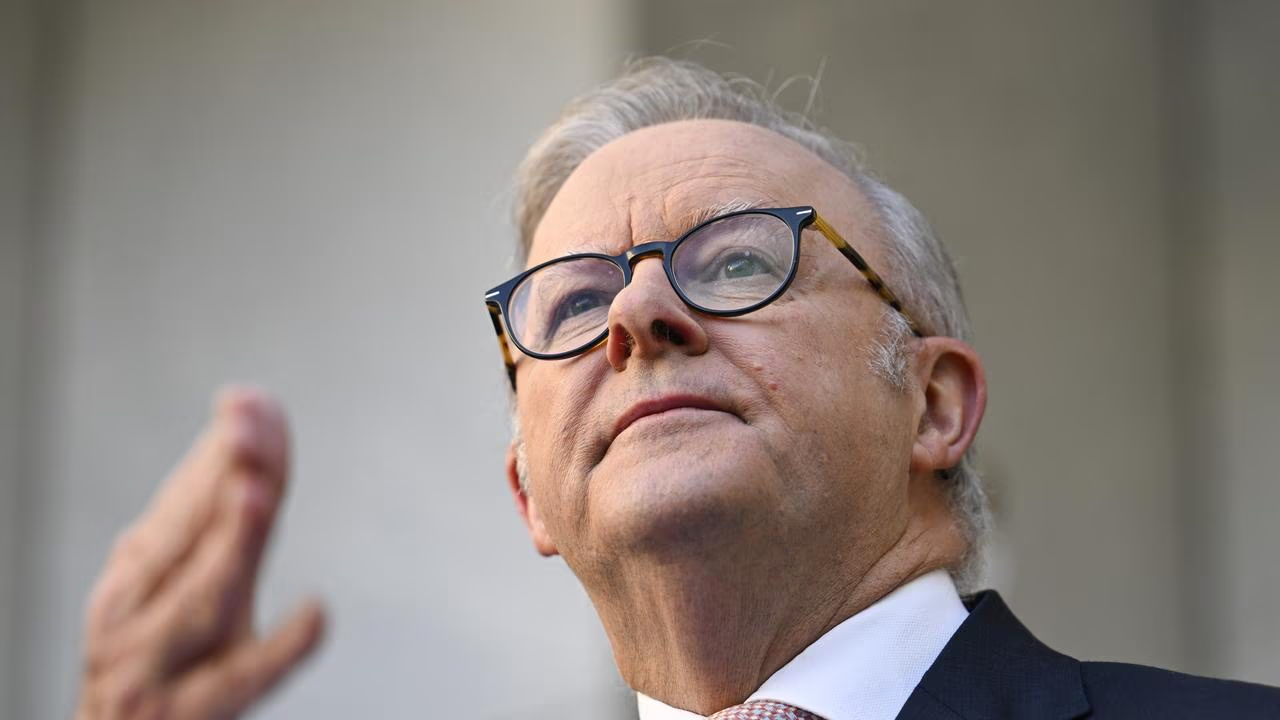
Australia Prime Minister Anthony Albanese has authorised a Royal Commission in the aftermath of the Bondi Massacre. The Bondi Massacre has renewed calls for Hate-Speech Laws to be passed.

Australia’s renewed push to strengthen hate‑speech laws, after the Bondi Massacre, has stirred up a familiar conversation across the Tasman. Whenever one democracy tightens the boundaries of acceptable speech, its neighbours inevitably ask themselves the same questions: What exactly are we trying to prevent? Do these laws work? And how do we avoid repeating the mistakes of the past?

To answer those questions, it helps to step back and look at the long, winding history of how societies have tried to regulate dangerous speech — from medieval blasphemy laws to modern hate‑speech statutes — and how New Zealand found itself wrestling with these issues in recent years.

Before “Hate Speech”: The Era of Proto‑Laws

Long before anyone coined the phrase “hate speech,” societies were already policing words. But the targets were very different from today.

Early speech restrictions were designed to protect the powerful, not the vulnerable. Medieval and early‑modern Europe punished blasphemy, heresy, and insults to monarchs. Sedition laws protected the state. Public‑order laws punished speech that threatened stability. These weren’t hate‑speech laws — but they were the ancestors of modern speech regulation. They recognised that words could inflame, destabilise, or provoke violence.

They were, in a sense, proto–hate speech laws: early attempts to control dangerous expression, but aimed at shielding institutions and dominant religions rather than minority communities.

Weimar Germany: A Warning From the Middle Ground

By the early 20th century, democracies began experimenting with laws that looked closer to what we recognise today. The Weimar Republic had statutes against inciting hatred, insulting religious communities, and spreading inflammatory propaganda. These laws were used — sporadically — against Hitler and the Nazi Party.

But they were weak, inconsistently enforced, and applied by courts often sympathetic to nationalist rhetoric. They failed not because the idea of regulating incitement was flawed, but because the state enforcing them was collapsing.

This failure became a turning point. After the war, the world understood that propaganda and dehumanising rhetoric weren’t abstract harms — they were precursors to genocide.

After the Holocaust: The Birth of Modern Hate‑Speech Law

Modern hate‑speech laws are a post‑WWII creation. Germany led the way with strict bans on Nazi symbols, Holocaust denial, and incitement against groups. These laws influenced the European Convention on Human Rights, UN anti‑racism conventions, and the frameworks adopted by Canada, the UK, and others.

For the first time, speech regulation was designed to protect vulnerable minorities, not the state or the dominant religion. The moral logic was clear: if hateful propaganda helped pave the road to genocide, democracies had a duty to intervene earlier.

But even with this moral clarity, the practical challenges remained.

The Drafting Dilemma: Why Hate‑Speech Laws Are So Hard to Get Right

Even supporters of hate‑speech laws acknowledge the same recurring problems.

Definitions are slippery.
Words like “hatred,” “insult,” and “hostility” are subjective. What one person sees as critique, another sees as bigotry.

Enforcement can become political.
Police and courts must interpret emotional concepts. That opens the door to inconsistency — or misuse.

Ideas are not people.
Laws should protect individuals from harm, not shield belief systems from criticism. When religion becomes a protected category, the line between hate‑speech law and blasphemy law can blur quickly.

Effectiveness is mixed.
Countries with strong hate‑speech laws still experience rising extremism. The laws can reduce public displays of hate, but they rarely change underlying prejudice.

These tensions are exactly what Australia is grappling with now — and what New Zealand confronted recently.

New Zealand’s High‑Threshold Approach

New Zealand has some of the narrowest hate‑speech laws in the democratic world. Under the Human Rights Act 1993, only racial incitement is covered. The threshold is high: the speech must be threatening, abusive, or insulting and likely to incite hostility or contempt.

Religion, gender, sexuality, disability, and political belief are not included. Most offensive or hateful speech is not illegal unless it crosses into threats, harassment, or incitement to violence — all of which are already covered by the Crimes Act and other statutes.

This approach reflects a strong cultural preference for free expression and a reluctance to criminalise attitudes rather than actions.

The Push to Add Religion — And Why It Backfired

After the Christchurch mosque attacks, the Royal Commission recommended expanding hate‑speech protections to include religion. The government proposed amending the Human Rights Act so that “insulting” or “hostile” speech about religious groups could become a criminal offence.

The reaction was swift and intense.

Critics warned that criminalising “insults” to religion risked creating a de facto blasphemy law — just two years after New Zealand had formally repealed its old blasphemy offence. The concern wasn’t abstract. Around the world, laws protecting religion from “insult” have been used to:

  • Suppress theological disagreement
  • Silence ex‑believers
  • Chill academic study of comparative religion
  • Shield harmful practices from scrutiny
  • Protect ideas instead of people

Public submissions overwhelmingly argued that the proposal would undermine open debate, academic freedom, and the ability to challenge belief systems — all essential in a pluralistic society.

In the end, the Law Commission declined to include hate‑speech reform in its work programme, and the government withdrew the proposal entirely.

What Australia Can Learn From New Zealand’s Experience

Australia’s debate is unfolding in a global context where hate‑speech laws are common but their effectiveness is mixed. The New Zealand experience offers a quiet but important lesson: even well‑intentioned reforms can stumble when they risk suppressing legitimate debate, especially around religion.

The challenge is not whether to protect vulnerable communities — everyone agrees on that. The challenge is how to do it without sliding back into the old pattern of protecting belief systems from criticism, the very thing modern democracies have spent decades moving away from.

If Australia wants to avoid repeating history — both ancient and modern — it will need to draft with extraordinary care, clear thresholds, and a firm commitment to protecting people rather than ideas.

The latest newsletter is out!

NZFOI Newsletter 202602

The latest newsletter is out and it may be downloaded from here: Download Newsletter.

We continue to have email deliverability issues to email accountholders from the following services:

  1. Gmail
  2. Hotmail
  3. Yahoo
  4. Xtra

If you know someone who should be receiving the email and uses one of these email services, feel free to forward the newsletter to them.

Otherwise they may miss out on upcoming events.  The next event is on Saturday, January 31, see page 8.

Thanks again for your support.  

What Anti-Zionism Really Is

We came across this thought provoking article and realised its importance in documenting this new evolutionary step of Antisemitism to become “Anti-Zionism.”

After October 7, friends called me ‘filthy Zionist.’ Longtime colleagues refused to work with me. This isn’t criticism of Israel. It’s about making Jews pariahs. By Adam Louis-Klein, 10.07.25 —Israel

After three months in a remote Amazonian village with no internet or phone signal, I returned to a small Colombian town on October 9, 2023—still in the rainforest, but now with internet—and checked social media for the first time. The jungle was still in my ears—squawking macaws, torrential rain, the low hum of a generator—when my screen filled with images from another world entirely: young people sprinting through dust and gunfire at the Nova music festival in Israel.

I had crossed between worlds, only to find that the world I returned to was no longer the same.

The deeper shock came in the hours that followed, as I scrolled through the reactions of friends and colleagues. Denial, justification, and open hostility toward anyone who expressed care for Israelis. I typed a simple phrase—Am Yisrael Chai, “the people of Israel live”—and learned that, in my circles of left-wing academia, that too was considered an act of aggression.

Almost immediately, I saw that a colleague had commented with a photo of people burning an Israeli flag. A former friend declared that my words revealed me as nothing but a “filthy Zionist.” Longtime intellectual collaborators informed me it was unacceptable to work with me given my support for the Jewish people. For them, even calling Jews a “people” was offensive and “right-wing.”

In the days following October 7, I was already experiencing what Marion Kaplan, in her study of Jewish life under Nazi Germany, terms “social death”—complete ostracization and the cutting of one’s previous social bonds. I was beginning to understand that to be a Jewish intellectual—to be a person who speaks in a Jewish voice, and who sees his fate as bound up in the collective fate of the Jewish people—was simply not something the academy could accept.

But I wasn’t about to submit. I knew that Jewishness was as legitimate a site as any identity from which to think, reason, and argue.

That was two long years ago. I have learned much in refusing to submit. Not just about the marginalization of Jews in the universities of the West, but about the enduring value of distinct peoples and voices—even in the face of a powerful ideological movement that uses the language of pluralism to conceal its demand for total conformity.

The Anti-Zionist Worldview

I had always been a good student. At my prep school, we read Antigone in Greek and the Aeneid in Latin. At Yale, I worked my way through the Western canon, from Aristotle to Hannah Arendt, in the Directed Studies program.

I first became an anthropologist because I was searching for something beyond the Western philosophical tradition I had studied. I wanted to understand worlds that were not my own. What I didn’t quite understand was that the twenty-first-century academy would demand that I disavow my own.

By the time I began my PhD, I was fully immersed in the critical, anti-colonial thought that now dominates the academy—an orientation bent on interrogating and dismantling the West. But living alongside the Desana, an indigenous group in Brazil and Colombia, ultimately brought me back—back to an embrace of my own Judaism and back to my Western inheritance as one tradition among others. Instead of thinking against the West, I came to see the value of thinking across civilizations, between living peoples and the worlds they continue to sustain.

The Desana of the Vaupés region, in today’s Brazil and Colombia, are often described as marginal to the global economy. But in their own eyes, they stand at the center of the universe—a chosen people with a unique story. They call themselves the Ümücori Masa, the universe-people, descended from the universe-person, or God.

For them, chosenness simply means peoplehood. In the early twentieth century, Catholic missionaries destroyed their traditional longhouses and forced them into mission towns. The surrounding Spanish-speaking society showed little interest in their memory or survival. In response, the Desana have fought to preserve their sacred names and endure as a people.

In the same way in which antisemitism once cast the Jew as the world’s metaphysical enemy, anti-Zionism now casts Israel and its supporters in the same role.

Today, we work together to translate old texts about the Desana into their own language—restoring the name of their God, re-centering their sacred lineages, and helping turn the historical record into a living part of their future.

Their struggle to remain themselves in the face of erasure echoed 3,000 years of Jewish history and what I found on my return: a so-called liberal world where Jewish distinctiveness is no longer tolerated, where Jewish continuity is recoded as a threat, where Jewish power is seen as illegitimate.

Nowhere is that worldview more powerful than in the academy. There, educated elites are being taught that it is righteous to hate Jews.

They call that world view anti-Zionism.

While anti-Zionism introduces itself as a “political opinion,” I came to see that it was something else entirely. Anti-Zionism, like antisemitism, is an entire cosmology. In the same way in which antisemitism once cast the Jew as the world’s metaphysical enemy, anti-Zionism now casts Israel and its supporters in the same role.

I began to study anti-Zionism the way I might study any culture’s system of meaning: its myths, rituals, and taboos. It functioned as a symbolic system, its force drawn from recurring metaphors—genocide, settler-colonialism, apartheid—ritually deployed not to clarify but to accuse, forming a closed circuit of moral judgment, reproduced across academia, media, and international organizations.

A major mistake would be to think that anti-Zionism is opposition to Zionism as an actually existing political ideology. Instead, it constructs a fantasy “Zionism” as a cosmic symbol of global injustice itself, one in which every possible crime—including U.S. police violence, trans exclusion9/11, even the climate crisis—converges in the image of Israel’s evil.

The central operation of anti-Zionism is libel. Anti-Zionists bypass the charge of antisemitism by redirecting their defamation at Israel and “Zionists” rather than Jews. By repeating accusations without serious demonstration or credible sourcing, they produce the appearance of an incontestable reality: a displaced evil attributed to “Israel.”

Anti-Zionists repeatedly claim that they are simply criticizing Israel. What makes the difference between critique and libel is not what is said, but how it is proffered, whether it belongs in the space of reason—answerable to refutation—or travels merely through repetition.

People who have been targeted by anti-Zionism know the difference. They are not reacting to individual opinions but to an organized movement that marks Jews as suspect through their association with a libeled Israel. The common deflection—that Jews “assume” criticism of Israel is antisemitic because they believe in some “inherent link” between Israel and all Jews—misses the point entirely.

The central operation of anti-Zionism is libel. Anti-Zionists bypass the charge of antisemitism by redirecting their defamation at Israel and “Zionists” rather than Jews.

In truth, it is a projection by those uncomfortable with being called antisemitic, who may not understand how anti-Zionism actually works—as a closed system of accusation, designed to force Jews to disavow their identities.

What makes anti-Zionism so seductive in academia is the way it cloaks itself in the moral language of human rights. Words like decolonizationanti-racism, and solidarity circulate as moral currencies, exchanged for prestige and authority in the academy. Yet behind this pose of inclusion, anti-Zionism works as an exclusionary ritual.

For example, when I proposed hosting a single academic talk at my university, McGill, on the antisemitic genealogies of anti-Zionism, particularly on the Soviet roots of so much of today’s anti-Israel sloganeering—amid at least 10 events in my department on the so-called Gaza genocide—my request was denied without explanation.

Another colleague warned that the journal I worked on would become “untenable” if it published anything that spoke positively about Jews. The perspective rooted in Jewish peoplehood was simply not to be part of the conversation.

The Forgotten History

To understand how the anti-Zionist worldview took hold, we have to look at the history it so carefully avoids. For a movement so obsessed with historical injustice, it remains almost entirely ignorant of its own origins.

But its genealogy is not mysterious, if you care to look.

The Grand Mufti of Jerusalem, Haj Amin al-Husseini, collaborated with the Nazis, met with Hitler, and broadcast antisemitic propaganda to the Arab world. Husseini worked closely with the Muslim Brotherhood, one of whose offshoots eventually became Hamas.

GettyImages-1371380021.jpg
Haj Amin al-Husseini, the Grand Mufti of Jerusalem, inspecting Bosnian volunteers of the Waffen SS while giving the Nazi salute, 1941. (History/Universal Images Group via Getty Images)

Following Israel’s victory over the Arab League in the Six-Day War of 1967, the Soviet Union took up the cause. Their strategy was clear: After the Soviet proxies lost on the physical battlefield, they turned to ideological and information warfare.

As Izabella Tabarovsky and others have documented, Soviet “Zionology” turned classical antisemitism into a global discourse of liberation. Zionism was no longer a Jewish national movement of Jewish liberation, but rather, a world conspiracy of “U.S-Israeli stooges” to undermine socialism and Third World revolution. Zionism was cast as a form of “Jewish imperialism”—a term with Nazi origins—and Israel as the world’s moral pariah.

Inside the Soviet Union, the consequences were stark. Jews were barred from emigrating to Israel, Hebrew was outlawed, and Jewish cultural associations were shuttered. Those who persisted were arrested and tried as “spies” or “traitors” to socialism. To live openly as a Jew, to insist on belonging to the Jewish people, was recast as political criminality—a climate that echoes in today’s elite institutions. These Jews became known as refuseniks: refused visas to Israel, but also refusing to submit to an anti-Zionist regime determined to crush their Jewish spirit.

Born out of the alliance between Nazism and Islamism, the rhetoric that was adopted by the Soviets ultimately found a global audience through the UN and its web of nongovernmental organizations (NGOs). In 2001, at the United Nations World Conference Against Racism in Durban, South Africa, these ideas went mainstream—thanks to a decades-long campaign by Arab nationalist regimes, Soviet propagandists, and the Organization of Islamic Cooperation (OIC), an umbrella group for the Muslim-majority states within the United Nations. The NGO forum revived the Soviet slogan “Zionism is racism,” circulated leaflets comparing Israel to Nazi Germany, and helped cement the “apartheid” libel in progressive discourse.

GettyImages-106475313.jpg
The Jewish Demonstration in front of Moscow’s Lenin Library on May 29, 1988, on the first day of the Gorbachev-Reagan summit. (Vitaly Armand/AFP via Getty Images)

This is how antisemitism got repackaged in the moral idiom of human rights. The tropes migrated across different aesthetics and discourses—Nazi, Islamist, Soviet, and now the postcolonial left—each time repositioning “Zionism” as the axis of global evil. What started as Nazism became human rights, while Zionists—the modern name of Jews—were recast as “the new Nazis.”

The Genocide Libel


Nowhere is the logic of anti-Zionist accusation more stark than in the charge that Israel is committing genocide. This claim also dates back to Soviet propaganda in the 1970s—and within days of October 7, it was being triumphantly revived by activist professors across the West. Having reframed Jewish peoplehood as inherently oppressive, anti-Zionism seeks to criminalize it altogether—by redefining Israel’s very being as genocide: the “crime of crimes.”

This maneuver rests not just on propaganda, but on explicit efforts to rewrite international law. A small circle of academics has worked nonstop over the past two years to erase the distinction between war and genocide. Dirk Moses, editor of the Journal of Genocide Research—which in 2024 devoted an entire issue to accusing Israel—has argued for abandoning genocide’s core requirement of intent to destroy a people. In its place, he proposes that all “settler-colonial” states are guilty by definition. Within this logic, Israel does not need to commit extermination to be genocidal; it is guilty simply for being.

While millions today are told that a “majority of genocide experts” believe Israel is committing genocide, few realize that this supposed consensus rests on a very small circle of academics whose self-avowed project is to redefine and even abolish the concept of genocide itself.

Meanwhile, another group of scholars, including leading experts on antisemitism, have rejected the genocide libel outright. Yet their voices receive virtually no coverage in the mainstream press, which prefers the spectacle of accusation to the discipline of debate—excluding Jews from the conversation unless they serve as tokens to legitimize anti-Zionism.

Legal scholar Avraham Russell Shalev, for example, has argued that October 7 itself meets the legal threshold for genocide, given Hamas’s clear intent to annihilate Israeli Jews. He also notes that genocidal actors have often made reverse accusations—a pattern seen with the Nazis, the Serbs, and the Hutus.

Anti-Zionism is not a spontaneous reaction to Israeli policy. It is a symbolic ideology with a specific history. Its moral authority depends not on truth, but on inversion—of victims and aggressors, of genocide and self-defense. It thrives not through argument, but through erasure. This is its deepest function: to delegitimize the Jewish claim to peoplehood by refashioning an old hatred in the language of justice.

What Indigenous Really Means

To truly understand anti-Zionism, we must examine what it seeks to erase: the indigenous connection between the Jewish people and the land of Israel.

Anti-Zionism construes Jews as “colonizers”: an alien, outsider presence in the Middle East. The colonizer libel not only erases Jewish belonging, but enlists Jews as scapegoats for everything modern Western culture now seeks to disavow: racism, imperial violence, settler domination.

In the months following October 7—while still engaged in my work with the Desana people in the Amazon—I set out to peel back the ideological layers wrapped around this fashionable term and recover what indigeneity really means.

At bottom, indigeneity is simply a way of being a people, one in which land and lineage are braided together at the root of identity itself. For the Desana, peoplehood is inseparable from the Vaupés River and the sacred sites along its banks. Their ancestors are said to have arrived upriver in a snake-shaped canoe, guided by primordial beings, who established the clan houses from which souls are born and to which they return.

In today’s academy, however, indigeneity has been reduced to a claim of victimhood at the hands of European colonialism. It is fundamentally a reactive identity—defined only in opposition to “white settler” power. This narrowing of meaning flattens the richness of civilizational difference. By this logic, Jews—now cast as symbols of whiteness, empire, and Western dominance—are excluded in advance.

Indigeneity has been reduced to a claim of victimhood at the hands of European colonialism. It is fundamentally a reactive identity—defined only in opposition to “white settler” power.

Such a framework cannot account for histories of conquest and displacement carried out by non-Europeans. The Arab conquests of the seventh century reshaped the Middle East and North Africa in ways that perfectly fit the “settler-colonial” model now applied to Israel. As Egyptian Jewish historian Bat Ye’or has shown, these conquests suppressed local languages, marginalized non-Muslim peoples, and absorbed indigenous populations into an imperial order—not unlike the Catholic missions in the Amazon.

Yet none of this fits the fashionable narrative. So it is ignored.

Anti-Zionism erases the Jewish story by casting Jews as foreign oppressors. Yet that story is one of exile and return: from Ur to Canaan, from Egypt back to the land of Israel, and after centuries of dispersion, return again. Indigeneity, in this fuller sense, is not a reactive label for the colonized but a structure of peoplehood—a way of inhabiting place, memory, and time.

The Desana, too, tell of a great migration—from the mouth of the Amazon upriver to the Vaupés, where the world took form. For the Desana, to belong is to descend from a journey and to return to its source. What the Desana are to the Vaupés, the Jews are to the land of Israel: a people at the center.

The Space of Reason

I had gone to the Amazon to learn how a people could live at the center of their own world—defined not by others, but by their own destiny. I came back to the erasure of my own.

In all of the spaces I had once thought of as home—universities, cultural institutions, humanitarian NGOs—an ideology that demands the erasure of me and my people has taken hold.

Anti-Zionism’s spread through the institutions of our liberal democracy is a test case for whether equality and justice can survive once they’ve been hollowed out and turned into weapons of exclusion.

This is not only about academia, and it is certainly not only about Jews. It is about defending the right of any people to exist as themselves, to live in security, and to speak in their own voice.

If we fail to defend those basic values, the future will belong to those who erase entire peoples from the human story, twisting the language of justice into tools of violence, intimidation, and propaganda. We cannot let that happen.

The right of every people to stand in the space of reason—to speak, to be heard, and to be recognized as equals—is not a gift from the powerful. It is the birthright of humanity.


Statement from the New Zealand Friends of Israel Association Inc.

We are deeply shocked and saddened by the tragic events at Bondi Beach during the Hanukkah celebration.

Our hearts go out to the Jewish community in Sydney and across Australia, especially the families affected by this senseless attack.

We stand in solidarity with you in grief and resilience, and offer our prayers and support during this painful time. May light and courage prevail over darkness.